Written by
Mark Davies
Managing Director, Doordrop Media
An interview with Mark Davies, Managing Director, Doordrop Media
Since joining Whistl in 2003, Mark Davies has been instrumental in building the profile of Whistl Doordrop Media and championing the strategic value of unaddressed mail. Through his leadership, the business has evolved alongside the wider industry, moving from a perception of door drops as a simple distribution channel to a data-led, accountable and trusted part of the media mix.
Beyond his role as Managing Director, Mark is a recognised industry figurehead. He is Chairman of the Board for the European Letterbox Marketing Association (ELMA), a board member of JICMAIL, initiated a long-standing partnership with Two Sides more than a decade ago, and is a strong supporter of the PrintGreen initiative. His outward-looking approach and commitment to collaboration have helped elevate both the channel and the businesses operating within it.
Mark's Journey at Whistl
Q. You joined Whistl back in 2003 and have held a number of senior roles before becoming Managing Director of Doordrop Media. Can you tell us about that journey?
A. I joined Whistl in January 2003 as an Account Director managing an account team. From there, I moved quickly through roles, including Group Account Director and Sales Director, before becoming Managing Director in 2008. It was quite a journey, but one that allowed me to really cut my teeth in front-facing, client-led roles, which have shaped how I still approach leadership today.
When I joined, the business was branded as Circular Distributors and was entirely focused on door drops. My time at Whistl has completely overlapped with its transformation from a pure door drop business into the broader organisation it is today. That has been fascinating to experience.
Door drops were often underestimated, even back then, in a pre- or early digital age. There was a perception that it was simply about putting leaflets through doors, but what really attracted me was how much data, science, and planning actually underpinned it. I have always enjoyed backing the underdog, and helping to build the channel's and the business's profile was a challenge I relished.
Data-driven Door Drops
Q. How do you see the door drop channel evolving in the UK and across Europe?
A. The channel has become much smarter and far more accountable. Door drops have always been targeted, but historically, we did very little in terms of evaluation and attribution. Over time, that has changed significantly.
We have invested heavily in data, talent and measurement to prove the value of the channel and to show where campaigns genuinely start, rather than relying on last-click attribution models that favour digital. That accountability has been crucial to the channel’s resurgence, particularly as brands reassess the dominance of Google and Meta within their marketing mix.
The Physical Impact of Print
Q. Door drops are sometimes seen as a traditional medium. What do people still underestimate about their effectiveness today?
A. People often underestimate the sensory and physical impact of print. When you physically engage with something, it is much more likely to be encoded in long-term memory. Door drops also have an enormous reach, wider than television or digital, and they can be targeted in a compliant and responsible way.
Another surprising factor is dwell time. Research shows that the average door drop stays in the home for around a week and is read for on average 60 seconds. When you consider that, alongside cost, door drops are one of the most cost-effective ways of acquiring attention, delivering around three times the effectiveness of social media.
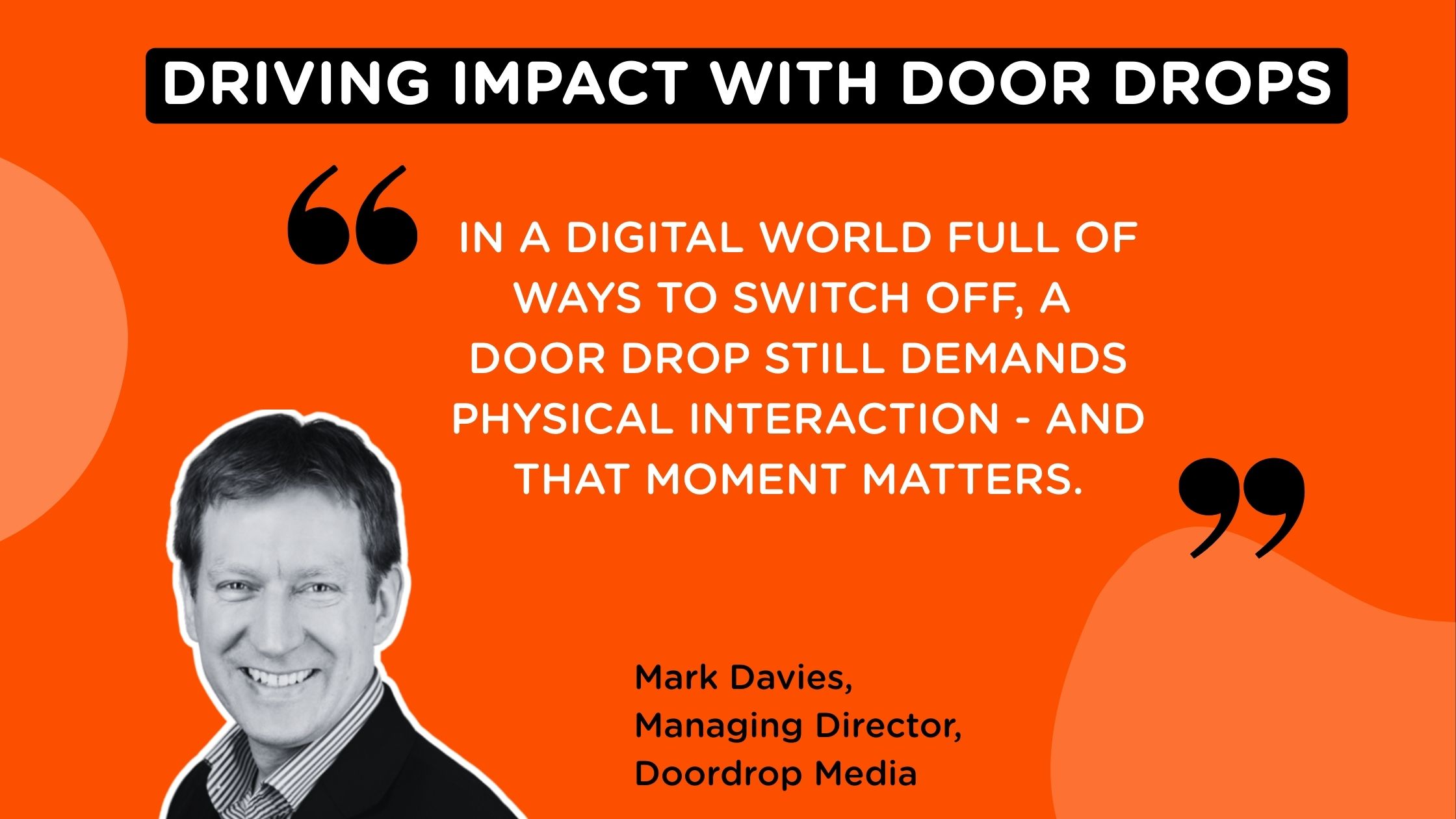
They are also immediately impactful. In a digital world full of ways to switch off, from ad blocking to skipped videos and overloaded inboxes, it is easy for people to avoid marketing messages altogether. With a door drop, you have to interact with it in some way, even if that interaction is simply the journey from the front door to the recycling bin. That moment of physical engagement matters.

Proving Reach and Engagement
Q. How are data, targeting and creative innovation changing the way brands use door drops?
A. There is now access to much richer consumer behaviour data, which allows us to tell a far more compelling story around reach, frequency and engagement. A major development for the industry has been the availability of more comprehensive consumer behaviour data through JICMAIL, which has enabled us to demonstrate how door drops perform. That includes understanding how many people see a leaflet, how often they interact with it, and the true scale of reach and frequency delivered in the home.
Combined with creative formats and relevant offers, this level of insight means door drops can be both highly effective and genuinely enjoyable for consumers, while giving brands far greater confidence in planning and measurement.
We are also exploring how artificial intelligence can support more predictive targeting and machine learning within our models. With billions of data points across millions of postcodes, AI has the potential to build on JICMAIL insights and drive even better outcomes for our clients.
Sustained Customer Value
Q. What are brands most focused on right now when it comes to unaddressed mail?
A. There is definitely pressure to demonstrate effectiveness, but I always encourage brands to take a more patient view. Door drops and print direct mail tend to perform particularly well when measured on lifetime value rather than short-term cost per acquisition.
Short-term metrics often favour digital channels, but lifetime value is far more meaningful at a business level and is much more likely to resonate with senior leadership.
This was clearly reflected in our success at the DMA Awards 2025, where Whistl Doordrop Media achieved a clean sweep of awards. The winning campaigns demonstrated how unaddressed mail drives sustained customer value, not just immediate response, reinforcing the importance of measuring effectiveness beyond last-click metrics. The DMA recognition provides independent validation that door drops deliver meaningful, long-term business outcomes when planned and measured properly.
Clarity Builds Confidence
Q. How does trust influence the value of door drops today?
A. Trust has become a defining issue in modern marketing, particularly as digital channels have grown in scale and complexity. One of the challenges facing the industry is that digital marketing has expanded rapidly, often at the expense of consumer trust, largely due to opaque data practices and the way personal data has been used.
Door drops and print, by contrast, consistently rank among the most trusted media channels, alongside television. Marketreach research repeatedly shows that consumers feel more comfortable engaging with physical, tangible media, and that trust plays a significant role in driving effectiveness.
This trust is closely linked to transparency and choice. Consumers understand what a door drop is, how it arrives, and why they are receiving it. There is no hidden data exchange, no algorithm making invisible decisions in the background. That clarity builds confidence in the channel.
Together, trust and reach form a powerful combination. As brands look to rebalance budgets away from over-reliance on digital platforms, door drops offer a proven, trusted and measurable way to engage audiences at scale and drive meaningful business outcomes.

Challenging Sustainability Myths
Q. Sustainability is becoming increasingly important. How is the door drop industry responding?
A. Sustainability has been a focus for us for well over a decade. We have long been members of Two Sides and now also support initiatives such as Love Paper Week and PrintGreen. The industry has made huge progress in responsible sourcing, production techniques and transparency.
There is still a misconception that print is inherently unsustainable, but the reality is very different. Print is one of the first channels able to accurately measure and report its carbon footprint. When compared with the environmental impact of digital infrastructure, print often stands up extremely well.
Door Drops Driving Growth
Q. Finally, what excites you most about the future of Whistl Doordrop Media?
A. What excites me most is the role door drops can play as a powerful new customer acquisition channel for digital-first brands. Many eCommerce businesses rely almost entirely on digital marketing, yet door drops can help them acquire high-quality customers who then go on to drive long-term value.
That creates a virtuous circle where we help clients grow their customer base, which in turn supports wider fulfilment and delivery services across the Whistl Group. There is a huge opportunity ahead.
Summary
Door drops have become a trusted, data-led and measurable channel that delivers scale, attention and long-term value. As brands reassess their reliance on digital, unaddressed mail offers a transparent, effective and sustainable way to engage audiences and drive meaningful business outcomes.
Join our mailing list
Sign up and receive all the latest industry news and insights directly to your inbox.
Research, Insights and Industry Guides
In depth insights and research studies to help you better understand customer perceptions & expectations.
Share this article
You may also like...