Written by
William Geldart
Content Manager
Striving to be a sustainable logistics business requires innovation, action, and collaboration. Our Whistl Group site teams have demonstrated all the above in finding a way to turn backing label paper into reusable waste.
Key Takeaways
- Backing label paper is a major contributor to general waste and is difficult to recycle through traditional waste management practices.
- Whistl site teams coordinated with Zest Recycle and label supplier GBF to find a sustainable solution to a common problem. As featured by Packaging Europe.
- This collaboration has introduced new waste management systems, which could convert 25 tonnes of label waste into new liner or paper products rather than sending it to landfill.
Finding a Sustainable Solution to Site-Wide Issues
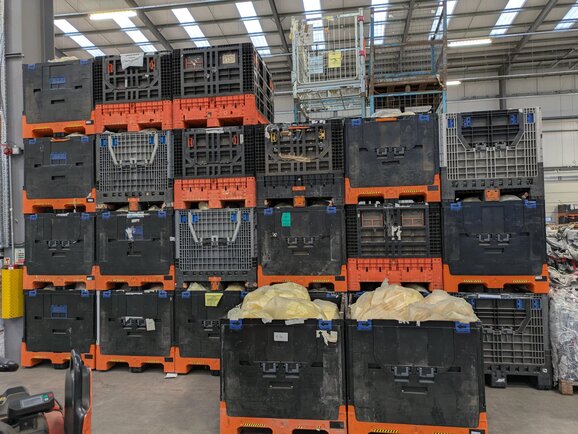
Backing label paper is the smooth, non-stick paper that labels come attached to. It’s commonly made from glassine paper, a material designed to be non-adhesive and moisture-resistant.
On the plus side, they’re perfect for packaging.
However, this type of label paper is difficult to recycle through traditional waste systems.
This issue was highlighted by our partners at Zest Recycle. We’ve worked together since 2021, and their thorough review of waste management across all our warehouses and depots highlighted the problem posed by backing label paper.
Ultimately, green logistics doesn’t happen in a vacuum.
We needed a collaborative solution designed to tackle this major contributor to waste and remove a large barrier to reaching our goal of ‘Zero Operational Waste to Landfill’.
As a result, Sam Urmston (Regional Estates Manager) and Carol Hopson (Depot Coordinator at Bolton) worked closely with Stewart Pitt (Account Manager at Zest Recycle) and our label supplier, GBF.
Together, they explored sustainable ways to address the issue and find a solution that would significantly reduce our waste footprint.
From Exploration to Implementation
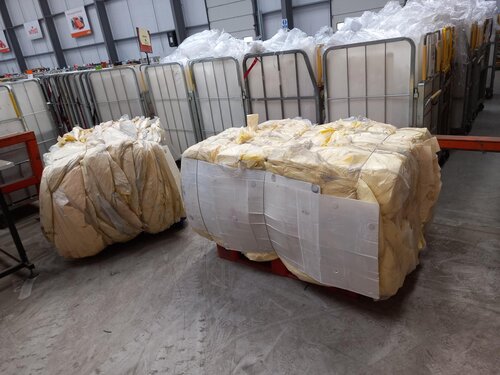
As a business, we use a high volume of labels for parcels, letters, and other items. The backing label paper typically ended up in the general waste stream, complicating recycling and disposal efforts due to its non-recyclable nature and tendency to contaminate other waste streams.
But now we’ve implemented a more structured approach. At the end of each station, the waxy paper is placed into its own bag and kept separate from other waste streams.
This has had a positive knock-on effect. By removing backing label paper from general waste, bins fill more slowly, and recyclable material is more easily separated or identified because it is more visible.
Since implementing a solution at the beginning of 2025, everyone has played their part in driving this waste separation habit.
This initiative was first rolled out to the North East depot and has since expanded to other parcel distribution sites in Nottingham. We’ve also extended it to our fulfilment sites in Wrangaton and Paignton. For our smaller sites, their waste is trucked to our Bristol depot for central processing and recycling.
Another key deliverable has been carbon reduction. Less waste produced has meant fewer transport journeys. General waste is now collected fortnightly, rather than weekly. Meanwhile, the bales of backing label paper we store need to be removed only quarterly.
We’ve iterated on our processes over time, ensuring fewer collections and more efficient on-site waste storage.
Measuring Our Impact on Sustainability
We track the success of this initiative on a quarterly basis. At our Bolton site, we typically handle 26-27 magnums of backing label paper, producing two bales. Each bale weighs approximately 750 kilos, and we expect to produce around 13-15 magnums per bale.
These metrics help us gauge the volume of waste diverted from general waste streams and assess the efficiency of the recycling process.
Perhaps the most significant impact is seen in what happens following collection. The bales of backing label paper are repurposed into new liners or paper products, eliminating the need for 325 trees' worth of virgin pulp.
This gives an ubiquitous waste product a second life and is arguably the most satisfying result of the initiative.
Finding a solution with a supplier has led to staggering results at Bolton. Backing label paper is not biodegradable or easily recyclable, so with no clear alternative it’s often disposed of. The team should be very proud of their impact on waste management. We are now eager to start rolling out to our other sites and carry on the great work.
Sam Urmston, Regional Estates Manager
The Next Steps in Waste Management
We’re already looking ahead. Our next step involves transitioning to liner-less labels, which will eliminate the need for backing label paper entirely.
We’re currently testing new printing technologies to assess speed and efficiency compared to our existing printers.
The ultimate goal is to fully negate the use of backing label paper, which will further reduce waste and enhance sustainability across our operations.
Our ESG Strategy and 2024 ESG Report outlines the steps we’re taking with ‘preserving our natural environment’ a key pillar. We will continue to take action through carbon reduction and sustainable waste practices in a bid to meet our company-wide goal of achieving Overall Net-Zero by 2045.
The targets we’ve set have been validated by the Science Based Targets initiative (SBTi) and the Whistl Group is proud to hold an EcoVadis Gold sustainability rating.
Share this article
You may also like...