
Written by
William Geldart
Content Manager
UK online shoppers are increasingly comfortable buying items from abroad, fuelling the growth of cross-border eCommerce. But for the optimum experience, customers told us they value transparency and certainty at every stage of the journey.
Our latest research, Ecommerce in 2026: The Search for Clarity and Convenience, provides a detailed look at how consumers navigate these purchases and what retailers must prioritise to build trust in the global marketplace.
Cross-Border Ecommerce: The Key Takeaways
Did you know?
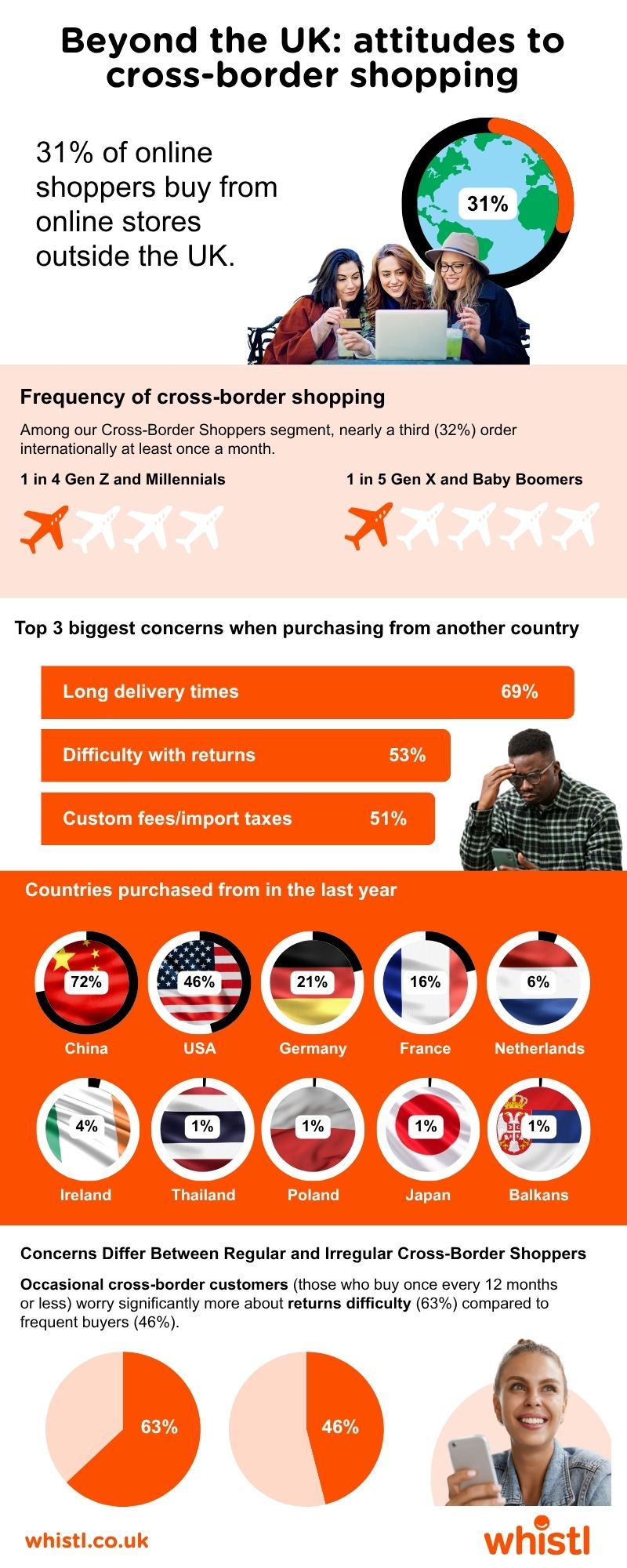
- 31% of all UK online shoppers buy items from overseas, highlighting a strong and stable market for global sellers.
- Nearly a third (32%) of Cross‑Border Shoppers buy internationally at least once a month, including 1 in 4 Gen Z and Millennials.
- The biggest concerns with cross-border shopping are long delivery times, difficultly with returns and unexpected customs fees.
- Younger Cross‑Border Shoppers are most worried about long delivery times, while Baby Boomers are more concerned about returns.
- Irregular Cross‑Border Shoppers are more anxious about returns than frequent international buyers.
What is the Appetite for International Shopping?
A sizeable 31% of UK online shoppers buy from abroad. Amongst our Cross-Border Shoppers segment, 32% do so at least once a month.
Gen Z and Millennials have the largest appetite for international shopping, with 41% of them buying from abroad at least once a month, compared to 23% of Gen X and 19% of Baby Boomers.
This highlights a generational shift toward global online marketplaces, driven by cheaper prices, greater variety, and product availability.
Elsewhere, 44% of Cross-Border Shoppers make international purchases every 3-6 months while 24% do so once a year or less.
Most Popular Cross-Border Shopping Destinations
The top countries UK shoppers purchase from are:
- China – 72%
- United States – 46%
- Germany – 21%
- France – 16%
- Netherlands – 6%
China’s dominance reflects its marketplace scale and low‑priced product availability, while the U.S and Western European neighbours remain strong sources for branded goods and specialist items.
According to data from ECDB, the UK has the third largest eCommerce market (£134bn) globally, ahead of European counterparts such as Germany (£94bn) and France (£60bn).
Meanwhile, the UK's high online share (percentage of goods sold online) of 28.6% further outlines its market maturity and attractiveness to international brands targeting additional revenue streams.
What are the Biggest Concerns with Cross-Border Shopping?
Respondents outlined their biggest concerns with cross-border shopping.
The top three are:
1. Long Delivery Times – 69%
Gen Z (70%), Millennials (70%) and Gen X (82%) were the most worried about long delivery times, more so than Baby Boomers (52%).
2. Difficulty With Returns – 53%
This represents another significant concern among Cross‑Border Shoppers. Baby Boomers (60%) are especially worried about returns difficulty, compared with 49% of Gen Z.
3. Customs Fees or Import Taxes – 51%
Unexpected duties erode purchasing confidence and make customers feel misled when costs aren’t clear upfront. This is common across Gen Z (54%), Millennials (53%) and Gen X (54%).
Other concerns include currency issues (19%) and language barriers (13%), with only 8% noting they had no concerns with cross-border shopping, 19% of whom were Baby Boomers.
Overall, younger shoppers seem most concerned about trust and surprise costs, while older shoppers worry more about whether returning items will be simple and hassle‑free.
How Do Concerns Differ Between Regular and Irregular Cross-Border Shoppers?
Behaviours and anxieties vary between frequent and occasional international buyers.
Frequent Cross-Border Shoppers are more comfortable with some of the less familiar processes which often come with international shopping. For example, they are less concerned about returns, with only 46% of these shoppers noting this as a worry.
However, irregular Cross-Border Shoppers (those who do so every 12 months or less) are more concerned with difficulty of returns, with 63% noting this as one of the main issues.
They are also concerned with unexpected custom fees (53%), and are more likely to abandon their carts if delivery times feel too long or vague.
Summary: The Future of Cross-Border Ecommerce
The UK’s hunger for cross-border eCommerce is strong, consistent, and increasingly shaped by transparency and convenience. Younger shoppers in particular are driving this trend, showing enthusiasm for international marketplaces and a high frequency of purchases.
But the findings are clear: to win and retain UK shoppers, international brands must address their biggest pain points - returns complexity and delivery speed. To do so requires the implementation of clearer communication, more predictable costs, and easier returns processes.
These operational improvements are now fundamental trust drivers, especially for first time or irregular cross border shoppers.
Download the full report to learn more about UK attitudes to cross-border eCommerce.
If you're looking to improve your international shipping options, get in touch to discuss how we can help you go global.
Share this article
You may also like...