Written by
William Geldart
Content Manager
As eCommerce continues to evolve, nowhere is the pace of change more evident than in the ways Gen Z and Millennial consumers are shopping online.
To help retailers stay ahead, we surveyed 1,000 UK adults, looking closely at how each generation behaves online, what motivates them, and the friction points that still undermine credibility and trust.
Gen Z (18–28) and Millennials (29–44) emerged as the most active, influential groups shaping future eCommerce trends.
These digital native groups are setting the tone for what “great” looks like across discovery, delivery, returns, and customer service.
Dive into Ecommerce in 2026: The Search for Clarity and Convenience and find out more about how Gen Z and Millennials are driving online shopping.
How Gen Z and Millennials are Shopping Online: The Key Takeaways
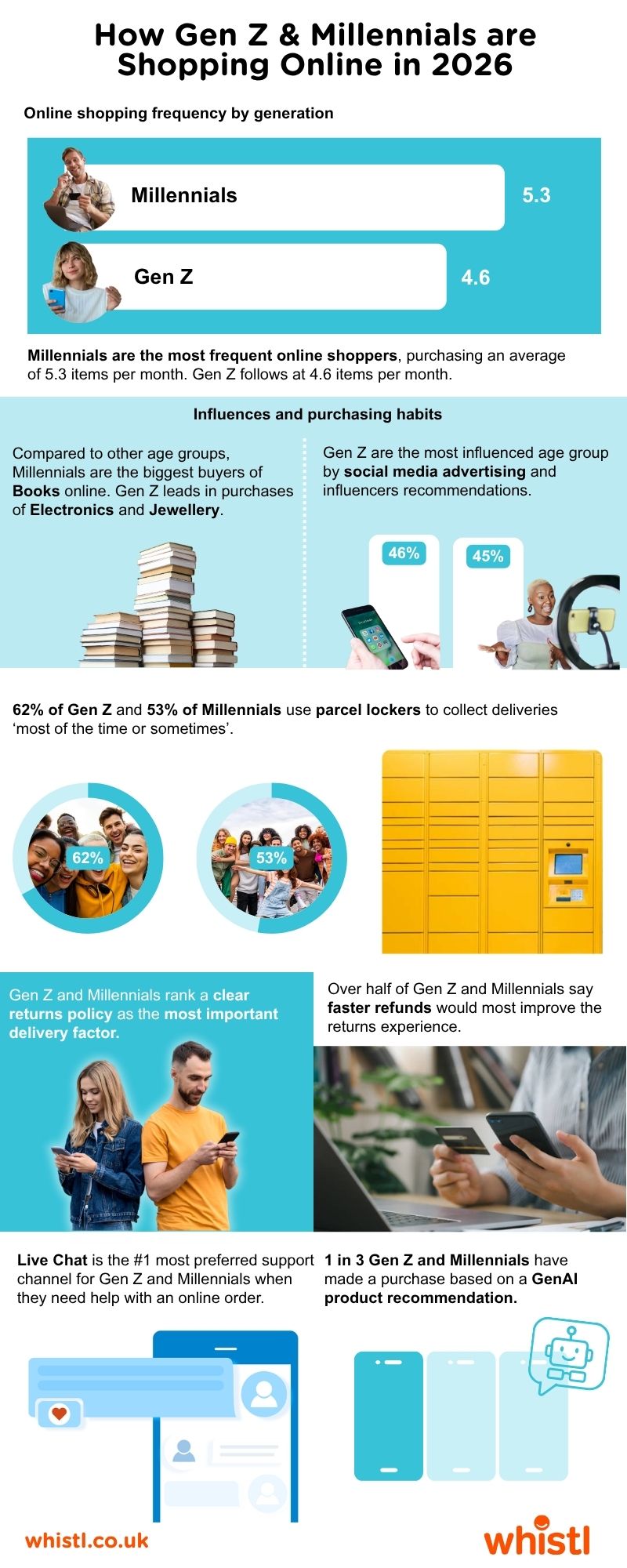
- Gen Z and Millennials shop online more than any other generation, averaging 4.6 and 5.3 purchases per month respectively.
- Clarity beats speed with the #1 delivery influence for all shoppers - including young buyers - a clear, returns policy (57%).
- 70%+ of Gen Z and Millennials buy using their smartphone, far higher than older generations.
- AI shopping adoption is accelerating with nearly 1 in 3 Gen Z and Millennials having made a purchase based on AI recommendations.
- Social discovery dominates with younger shoppers taking inspiration from social media ads, influencers, and out‑of‑home campaigns.
- Parcel lockers are booming, with over half of Gen Z and Millennials using one at least a few times a year.
- Customer service frustrations persist. Slow response times and difficulty reaching a human advisor are major pain points.
How Often Do Gen Z & Millennials Shop Online?
Gen Z and Millennials are the UK’s most frequent online buyers:
- Millennials average 5.3 online purchases per month.
- Gen Z average 4.6 purchases per month.
- Both groups shop nearly twice as often as Baby Boomers.
And what’s in the baskets of Gen Z and Millennial shoppers?
Here are the top three online shopping categories:
- Clothing (89% Gen Z, 88% Millennials).
- Footwear (60% Gen Z, 67% Millennials).
- Beauty (60% Gen Z, 63% Millennials).
Compared to other age groups, Gen Z are the biggest buyers of Electronics (58%) and Jewellery (43%) while Millennials dominate categories such as Books (50%) and Toys & Games (46%).
These shoppers are also heavy mobile users. Over 70% order via smartphone, shaping expectations around speed, UX, and seamless checkout.
How Gen Z & Millennials Discover Products
Across every generation, an online search remains the most likely prompt to purchase. But younger shoppers cast a far wider net.
Younger buyers are more influence‑sensitive than any other group
This means that Gen Z and Millennials are significantly more likely to respond to:
- Social media advertising
- Influencer recommendations
- Out‑of‑home advertising
- Promotional emails
Social Media Shoppers, a segment dominated by younger audiences, are particularly responsive to TikTok, Instagram, and YouTube recommendations.
For retailers, this reinforces the need for diverse, social‑ready content and always‑on brand visibility.
What Delivery Factors Influence Gen Z & Millennial Behaviour?
Despite their reputation for wanting everything “now”, young shoppers prioritise clarity and control just as much as speed.
Top delivery factors for Gen Z and Millennials:
- Clear returns policy (57%)
- Lowest delivery cost (55%)
- Delivery visibility & tracking (51%)
Speed still matters, particularly for Gen Z, where 71% use next‑day or express delivery. But it doesn’t trump transparency. In fact, frequent shoppers (including younger demographics) place quickest delivery only fourth in order of importance, behind clarity and visibility.
Eco expectations are rising too.
Gen Z and Millennials are more likely than older groups to say sustainability is “more important than last year”, especially when it comes to consolidated deliveries and recyclable packaging.
Returns: How Would Young Shoppers Improve the Experience?
Effective returns management remains a defining moment for customer satisfaction and younger shoppers have clear ideas on what they'd prioritise.
What Gen Z & Millennials want most:
- Free returns
- Faster refunds
- No‑print returns and easy labelling
- More drop‑off options, particularly: parcel lockers (41% Gen Z / 34% Millennials) and pick‑up points.
Younger buyers also use a wider variety of returns channels compared to Gen X and Boomers, who still prefer to return parcels via the Post Office.
Where Do Gen Z & Millennials Look for Trusted Recommendations?
Trust is still human-led for all generations. Friends and family top the list but Gen Z and Millennials have a much broader trust ecosystem.
They show higher trust in:
- Social media
- Influencers
- AI-generated recommendations
- AR/VR product previews
Notably, 45% of Gen Z and 53% of Millennials trust AI recommendations at least “somewhat”, compared to just 11% of Boomers.
Emerging Tech: How Gen Z & Millennials Use AI, AR and Social Commerce
These young consumers are leading the adoption curve.
AI Shopping
- Nearly 1 in 3 Gen Z and Millennials have already made a purchase based on a GenAI recommendation.
- Electronics and clothing & accessories convert best.
- 59% of Gen Z and 57% of Millennials say they’re “likely to buy” a product recommended by AI when it matches their needs.
AR/VR Try‑On
- Around half of Gen Z and Millennials have used virtual try‑on or AR previews.
- 7 in 10 rate their experience as engaging or useful.
Live shopping & pop-ups
- Over half have watched a live shopping event. Nearly 1 in 4 Millennials have purchased through one.
- Gen Z and Millennials are 2–4x more likely to visit pop-up stores than older generations.
This blend of digital and physical is becoming the new browsing journey.
Customer Service: The Biggest Frustrations for Younger Shoppers
Even with their digital fluency, Gen Z and Millennials still hit friction and want a human touch.
Top customer service frustrations include:
- Slow response times
- Difficulty reaching a real person
- Unresolved or poorly followed-up issues
Younger shoppers are multi‑channel in their support habits, using live chat, social messaging, and email. But they expect speed and authenticity across all touchpoints.
What This Means for Retailers in 2026
If UK retailers want to win (and keep) Gen Z and Millennial customers, the priorities are clear:
1. Build clarity and transparency into every stage of the journey
From returns to tracking, delivery, and visibility, younger shoppers want to know exactly what to expect.
2. Offer genuine delivery choice
Include lockers, pick‑up points, next‑day, scheduled slots. Let shoppers decide what works for them.
3. Modernise the returns process
Free returns, instant refunds, paperless options, and locker/pick‑up flexibility will become hygiene factors.
4. Lean into discovery channels that inspire young buyers
Social content, creators, OOH, live shopping, AR previews are key touchpoints where Gen Z and Millennials browse before they buy.
5. Embrace AI shopping responsibly
Shoppers are ready for tailored suggestions but only when they feel helpful, not intrusive.
6. Fix the customer service bottleneck
Human support still matters. Fast, empathetic escalation can be the difference between a lost customer and a lifelong advocate.
Closing Thoughts
Gen Z and Millennials buy more frequently than other age groups and continue to reshape the UK online shopping experience. Their expectations are higher, their channels more varied, and their tolerance for friction is increasingly low.
Retailers who create clear, convenient, and confidence‑building experiences stand to build the strongest relationships with the UK’s most influential online shoppers.
Download the full report to learn more about the buying behaviours of Gen Z and Millennials when shopping online.
And get in touch if you want to explore how to meet the needs of today's shoppers. We provide integrated fulfilment, parcel delivery management, returns and contact centres that enhance the customer journey.
Share this article
You may also like...