
Written by
William Geldart
Content Manager
As online shopping continues to grow, delivery costs, reliability, and expectations for customer service response can cause major frustrations for many shoppers and significantly impact the online shopping experience.
Our latest research, Ecommerce in 2026: The Search for Clarity and Convenience, has found that high delivery fees, damaged or missing items, and missed deliveries are common pain points of eCommerce shipping that leave customers feeling frustrated and disappointed.
As expectations continue to rise, understanding what frustrates shoppers most is essential. Also important is understanding how these concerns differ by generation, as this helps retailers tailor their approach to improve satisfaction, reduce churn, and remain competitive in an increasingly experience-driven market.
In this article, we drill down into what consumers find most frustrating when online shopping, including their delivery preferences, and what they value most from an online retailer.
Online Shopping Experience: The Key Takeaways
- Delivery cost is a loyalty lever: High delivery fees are the single biggest frustration, particularly among Gen X and Baby Boomers, making free or threshold-based delivery a powerful tool for retention and conversion.
- Reliability now competes with price: For Gen Z and Millennials, damaged or lost items and unreliable delivery are nearly as important as cost. Investment in fulfilment quality and tracking transparency is critical to maintaining trust.
- One size does not fit all: There is a clear generational divide: younger shoppers prioritise speed and seamless digital experiences, while older shoppers prioritise value. Delivery strategy should reflect these differing expectations.
- Customer support is a risk multiplier: When delivery issues arise, difficulty reaching a human agent, slow responses, and scripted replies significantly intensify frustration. Poor support turns operational issues into reputational damage.
- End-to-end experience drives competitive advantage: Retailers that balance cost efficiency, delivery reliability, digital ease, and responsive human support will strengthen customer satisfaction, loyalty, and long-term profitability.
What are the Biggest Frustrations with the Online Shopping Experience?
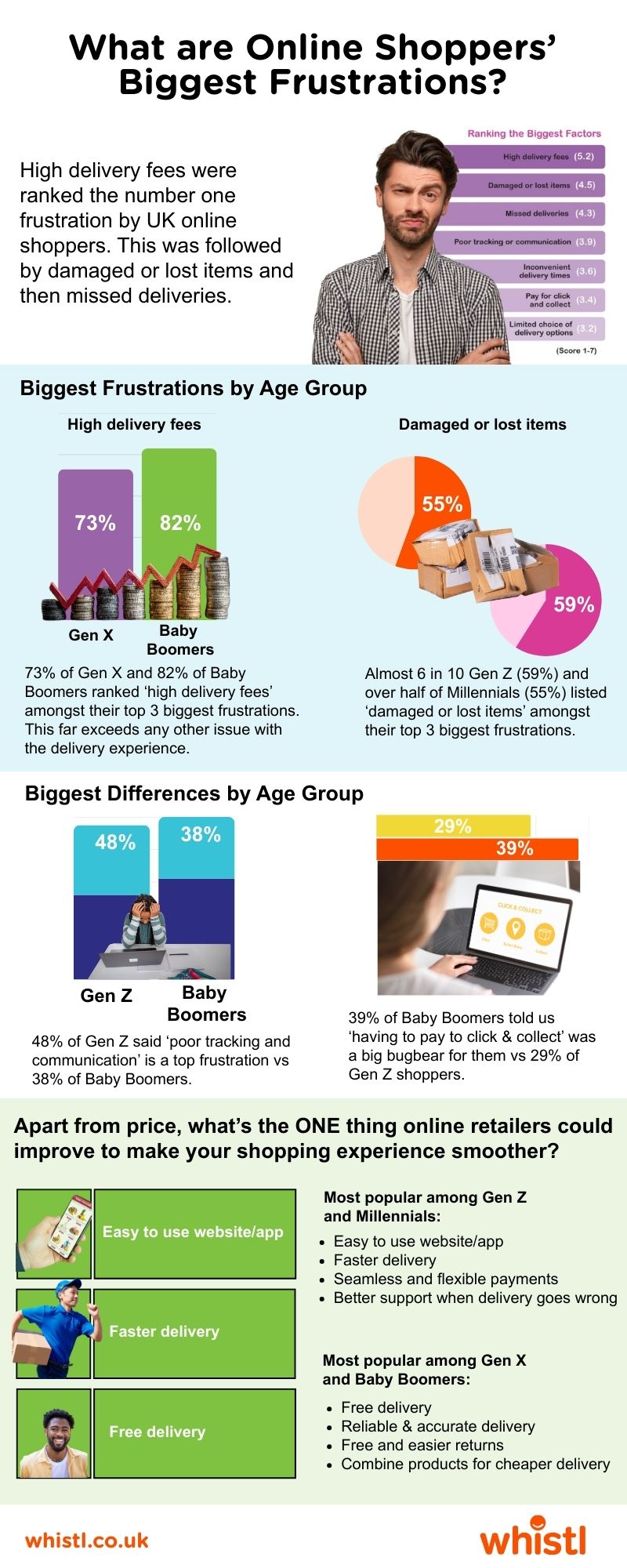
Delivery has become a defining part of the customer experience. Two-thirds of shoppers rank high delivery fees among their top three most frustrating aspects of online shopping overall (69%), with the highest rates among Gen X (73%) and Baby Boomers (82%). For these age groups, delivery costs directly affect perceived value and purchase decisions.
Gen Z (64%) and Millennials (57%) also dislike high delivery fees, but place almost equal importance on damaged or lost items. For younger shoppers, reliability and experience are as critical as price.
In addition, damaged or lost items (53%) ranked as the second most frustrating aspect of online shopping and missed deliveries (49%) as third.
These insights suggest that while delivery fees matter across all generations, younger consumers are more experience-driven, whereas older shoppers are more cost-driven.
Convenience vs. Cost: Age Divides Shopper Priorities
There is a convenience vs price-consciousness divide amongst age groups, reflected in the retail customer support they value most.
Gen-Z and Millennials value ‘easy to use website/app’ and ‘faster delivery’ while Gen X and Baby Boomers want ‘free delivery’ or products combined for cheaper delivery.
Overall, younger generations tend to focus on convenience, and older generations on cost:
- Gen Z and Millennials tend to prioritise a smooth, efficient shopping experience. They place high value on easy-to-use websites and apps, faster delivery, reliable tracking, and flexible payment options. For these groups, speed and convenience often outweigh the cost of delivery.
- Gen X and Baby Boomers, on the other hand, are more price sensitive. They are more likely to consider free delivery or combining products into a single shipment as the top improvements retailers could make. For them, delivery cost is a key factor in the overall value of a purchase, sometimes even more important than speed or convenience.
This generational split highlights the importance of tailored delivery strategies. Retailers can appeal to younger shoppers with faster, more flexible options, while engaging older shoppers with cost-saving incentives such as free or consolidated delivery. By understanding these differing priorities, retailers can better balance speed, convenience, and cost to meet the expectations of all age groups.
Improvement Priorities Differ by Gender
When asked what online retailers could improve to make their experience smoother, Gen X and Baby Boomers cited free delivery, but Gen Z and Millennials placed other concerns above this:
-
Easier to use website/app
-
Faster delivery
-
Reliable delivery
-
More seamless/flexible payment options
-
Better product information
This highlights a shift toward end-to-end experience optimisation, rather than focusing solely on delivery costs.
How to Improve the Online Shopping Experience
Introduce or expand free delivery options, especially targeting Gen X and Baby Boomers (e.g., minimum-spend thresholds or loyalty benefits).
Improve eCommerce shipping reliability through stronger courier partnerships, better tracking, and proactive communication around delays.
Reduce damage and loss of items through improved packaging, quality control, and clearer accountability with logistics providers.
Offer flexible delivery options, including delivery windows, safe-place options, and local pickup.
Enhance digital experience, particularly for Gen Z and Millennials, by improving site/app usability, checkout flow, and payment flexibility.
Strengthen customer support, ensuring faster access to human agents, clearer escalation paths, and more helpful, personalised responses.
Summary
Delivery remains a critical driver of satisfaction within the online shopping experience. While high delivery fees are the most common frustration across all shoppers, generational differences show that cost, reliability, and experience must be balanced.
Retailers that combine fair pricing, reliable delivery, strong digital experiences, and responsive retail customer support will be best positioned to meet evolving consumer expectations and build long-term loyalty.
Discover the full insights behind how delivery challenges are shaping the online shopping experience and what retailers can do to fix them.
Share this article
You may also like...