Written by
William Geldart
Content Manager
Online deliveries are playing an increasingly decisive role in shaping the overall online shopping experience, influencing everything from purchase confidence to long-term brand loyalty.
From clearer online returns policies to real-time delivery visibility and more sustainable fulfilment choices, shoppers are raising the bar for what good online delivery looks like..
Our latest research, Ecommerce in 2026: The Search for Clarity and Convenience, explores these changing expectations in detail.
The insights come from an online survey of 1,000 UK adults aged 18–79 who regularly shop online for non-grocery items.
Reflecting the UK population across age, gender and region, the research captures a realistic snapshot of everyday shopping behaviour and expectations. It explores how preferences are shifting beyond standard home delivery, with growing adoption of options such as click and collect and parcel lockers, alongside rising expectations for online returns.
The findings provide retailers with practical insight into how to strengthen their online delivery strategies and meet the demands of today’s online shoppers.
Online Deliveries: The Key Takeaways
- Clear online returns policies, low delivery costs, and order tracking are the top factors influencing online deliveries.
- Sustainable delivery options such as consolidated deliveries and recyclable packaging are rising in priority.
- Frequent online shoppers prioritise convenience, speed, and sustainability over cost, while infrequent shoppers are more price-sensitive in their online delivery choices.
- Standard home delivery still dominates, but younger shoppers are using alternative methods such as click and collect and parcel lockers.
- Parcel lockers are becoming a preferred delivery and collection method for younger and frequent shoppers.
- Shoppers expect online returns to be easy, free, and flexible.
What are the Top-Ranking Delivery Factors Influencing Online Deliveries?
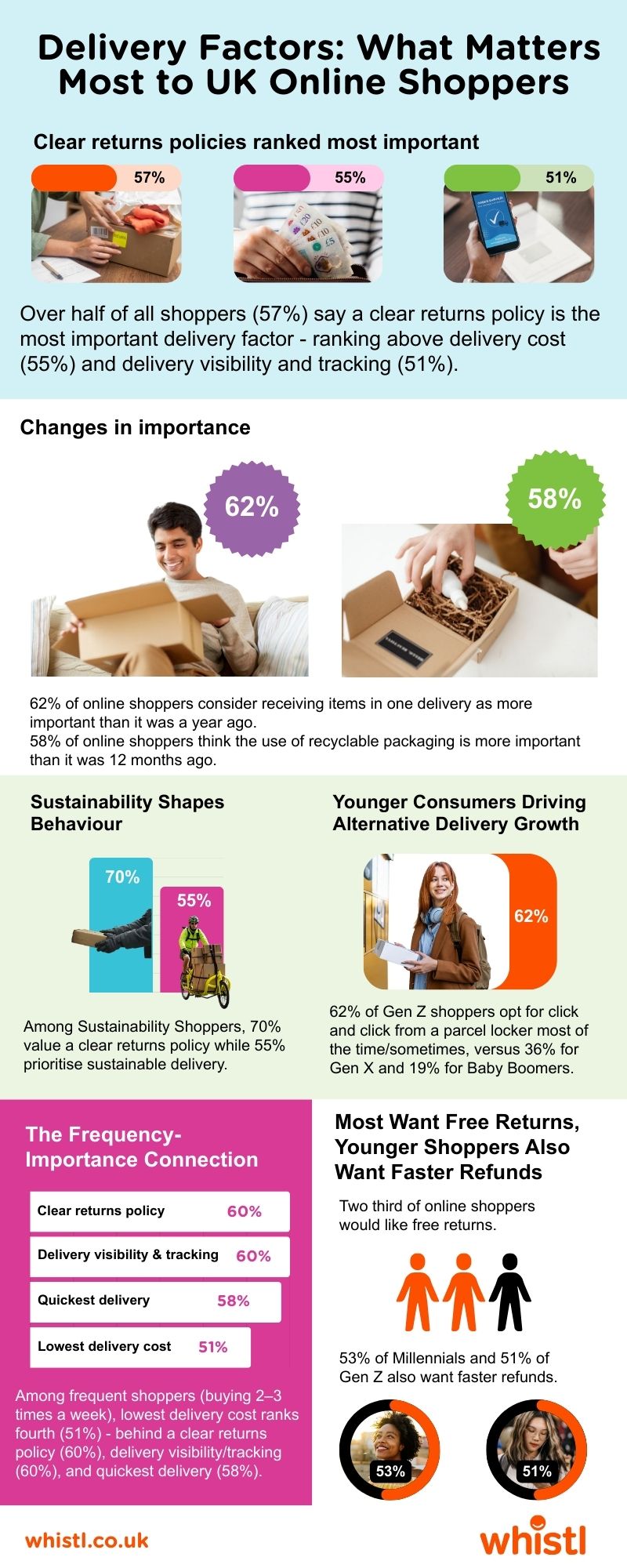
Over half of UK online shoppers state the following factors are extremely important when making their purchasing decisions. Here are the top three factors:
- 57% - A clear online returns policy
- 55% - Lowest delivery cost
- 51% - Delivery visibility or tracking
This highlights how strongly delivery decisions are shaped by the demand for clarity and convenience, with cost relegated to second place.
For sustainability-focused shoppers, expectations are even higher: 70% rate a clear returns policy as extremely important, while 55% place similar importance on green or sustainable delivery options.
This indicates that environmentally conscious consumers expect both flexible online returns and responsible delivery practices as part of a positive shopping experience.
How have Delivery Priorities Changed Over the Past 12 Months?
Over the past year, delivery-related priorities have either increased in importance or remained stable for most shoppers.
Preferences for receiving items in consolidated deliveries and for recyclable packaging show the strongest growth, with over half of shoppers saying these are now more important than they were 12 months ago.
A sizeable 62% of the total sample told us that receiving all items in one delivery was ‘extremely important’ or ‘somewhat important’ compared to 12 months ago. Meanwhile, 58% now view the use of recyclable or compostable packaging as a more important delivery factor.
Younger shoppers, Gen Z and Millennials, are more likely than Gen X and Baby Boomers to say eco-related delivery considerations matter more to them now. This points to a steady move toward sustainability becoming an expectation within online deliveries, driven by younger shoppers.
How Does Shopping Frequency Shape Delivery Attitudes?
Delivery preferences vary significantly depending on how often consumers shop online. Among frequent online shoppers, those purchasing two to three times per week, lowest delivery cost ranks only fourth in importance, behind a clear returns policy, delivery visibility or tracking, and fastest delivery.
For frequent online shoppers, these are the top factors influencing their online delivery habits:
- 60% value a clear returns policy
- 60% consider delivery visibility and tracking as most important
- 58% prioritise fastest delivery
- 51% consider lowest delivery cost a top priority
By contrast, shoppers who only purchase online every one to three months place lowest delivery cost firmly at the top of their priorities.
Frequent shoppers are also more likely to report that sustainability-related factors have grown in importance over the past year.
This suggests that as online shopping becomes more habitual, consumers place greater value on convenience, reliability, and sustainability, rather than focusing on price alone.
What are the Most Popular Delivery and Collection Methods?
Standard home delivery is the most preferred method with almost all consumers using it at least some of the time. Around eight in ten shoppers say it is their preferred option, largely because it allows them to stay at home and because they trust the delivery process.
Younger shoppers are more likely to use a mix of delivery and collection options rather than relying solely on home delivery.
Among those choosing alternatives, in-store collection is valued for its ability to be combined with other shopping, while the click and collect option appeals due to convenience and reduced risk of missed deliveries.
How are Parcel Lockers Reshaping Delivery and Collection?
Parcel lockers are becoming an increasingly important part of the delivery landscape, especially for younger and more frequent online shoppers. Over half of Gen Z and Millennials use parcel lockers at least a few times a year, compared with around one third of Gen X and just over one in ten Baby Boomers.
Among frequent users, more than half (52%) say lockers are much more convenient than home delivery, mainly because they reduce missed deliveries, are located nearby, and allow faster collection.
Concerns vary with frequent users more likely to worry about lockers being full or not opening properly.
Less frequent users and non-users focus more on inconvenient locations and potential risks of theft or tampering.
Overall, parcel lockers are reshaping online delivery by offering a flexible, convenience-led alternative being utilised by younger, high-frequency shoppers.
How do Online Shoppers Feel about Online Returns?
Most online shoppers report relatively few major issues with online returns, with only 15% describing the process as somewhat or very difficult. However just 16% say returns are very easy. With the rest falling somewhere in between.
Preferences for return methods vary by age and shopping behaviour. Around two thirds of Gen X and Baby Boomers prefer returning items via the Post Office, while Gen Z and Millennials are more likely to try alternatives such as pick-up points, parcel lockers, or Royal Mail Parcel Postboxes.
Across all groups, free returns are a clear expectation for two thirds of shoppers, while faster refunds are particularly important to Gen Z and Millennials. For those who struggle most with returns, the biggest improvements would be home collection, not needing to print labels, and access to free returns.
Summary
Shoppers’ expectations for online deliveries are evolving toward convenience, transparency, and sustainability. Younger and frequent buyers are driving the growth of options like parcel lockers, click and collect, and eco-friendly delivery methods. At the same time, clear, flexible, and free online returns remain a priority, making seamless returns a key factor in the modern online shopping experience.
Download the research to learn more about what matters most and how behaviour differs across age groups and shopper types.
Join our mailing list
Sign up and receive all the latest industry news and insights directly to your inbox.
Research, Insights and Industry Guides
In depth insights and research studies to help you better understand customer perceptions & expectations.
Share this article
You may also like...