
Written by
William Geldart
Content Manager
Trust plays a huge role in an organisation’s ability to build relationships and drive commercial actions. But not all channels are the same. Inside Mail has explored the role of trust in communications, with an emphasis on mail and the charity sector.
This event is the first in a new series that will explore innovation and impact within mail marketing - including business mail, direct mail and leaflet advertising.
In this edition, Whistl Mail’s Laura Sanjurgo (Commercial Director) and Jen Rufus (Head of Product Strategy and Industry Engagement) were joined by John Eddolls and Mark Griffith from Marketreach.
John and Mark took a deep dive into The Trust Factor, a research piece that has revealed the true value of trust and why it matters for charities.
Why Trust Matters Most for Charities

Trust is vital and once broken it is incredibly difficult to rebuild. Marketreach found that charities are often held to much higher standards than brands and retailers. This is supported by the fact that 46% of adults who have not donated to charity in the last six months cite a lack of trust in charities to spend their money responsibly.
The importance of trust cannot be understated when crafting a charity campaign.
Marketreach found that trust is the second biggest driver of brand relationships. A sizeable six out of 10 (59%) respondents said that trust is an important factor when choosing a brand or organisation, only behind ‘value for money’ (64%).
Trust is also key to driving commercial actions.
A whopping 92% of consumers will ‘act’ or ‘do something’ if they trust a brand. Meanwhile, 74% act in a commercially impactful way, such as participate in a loyalty programme, if they trust a brand.
Research Reveals Reasons for Not Trusting a Charity
A loss of trust represents a huge financial risk, whether you are a retailer or a charity. The Trust Factor revealed that 60% of those who previously used a brand, but have since stopped, said that a lack of trust was the deciding factor.
For charities, the top reason given for not trusting them is ‘negative media coverage or public scandals’. This is followed by ‘poor value for money’, not being environmentally or socially responsible and being bombarded.
Underlying this erosion of trust is negative coverage and poor communication. The latter can certainly be addressed through a communication strategy and channel selection that’s most likely to resonate with your charity donors.
Mail is the Most Trusted Communication Channel
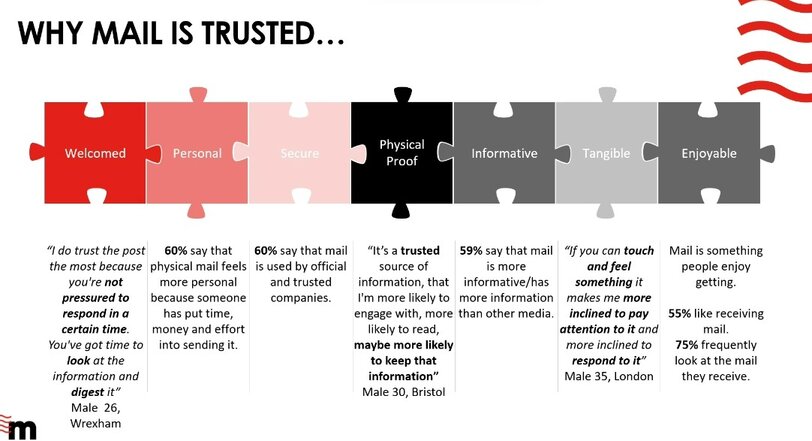
As part of its findings, Marketreach has outlined ‘the 8 pillars of trust’ and their respective impacts.
Here’s the full list, in order of which elements are most responsible for generating trust.
1. Reliability (35%)
2. Reciprocity (19%)
3. Aligned Interests (14%)
4. Stake (14%)
5. Familiarity (9%)
6. Frequency of Communication (2%)
7. Fame (2%)
8. Tenure (1%)
According to Marketreach, 50% of consumer trust is built from the brand – the source speaking to them. Next up, 42% is based on media, with only eight per cent generated by the creative.
However, the real kicker for running a charity campaign is the choice of channels.
Direct Mail and door drops have the biggest impact on trust, with the former generating two times the impact on trust compared to the next closest channel.
WATCH THE ON-DEMAND EVENT
Trust in Whistl for Charity Mail Management
Looking to build trust and donor relationships? Our mail management solutions help charities and fundraisers foster connections and achieve commercial results through direct mail, partially addressed mail and door drop advertising.
For example, Posthub - part of the Whistl Group, helped Michael Sobell Hospice launch their first mail campaign. Also, Shelter increased Freewill referrals and achieved outstanding ROI through targeted leaflet advertising.
Speak to us today about cost-effective and reliable mail delivery.
Join our mailing list
Sign up and receive all the latest industry news and insights directly to your inbox.
Research, Insights and Industry Guides
In depth insights and research studies to help you better understand customer perceptions & expectations.
Share this article
You may also like...