
Case Study Swoon Editions

Whistl has studied the UK population to understand customer views on contact centres and provide guidance on how your businesses can create a strong customer experience.
Customer service is vital to your business and can underpin your company’s reputation. Understanding how to support your customers begins with reviewing the effectiveness of each contact option they have with your business.
Contact centres are often the first point of contact for your customers’ interactions, and knowing more about your customer’s expectations could help shape your customer service offering.
Our research-based study gives insight into the UK's preferences for contact centres, allowing more businesses to tailor their offering to meet the expectations of their customer base, increase customer loyalty, and avoid losing customers to competitors.
Browse our research guide index below to read more about sections that interest your business. You can also download the entire guide or our fact sheet to share with your team.
In a complex world, one thing that ties customer-facing companies together is the service levels they can offer. Since 2019, the UKCSI has reported on five dimensions of customer satisfaction. These variables can help you better understand your customer base, allowing you to improve the customer experience you provide and strengthen your relationship with them.
“Customer insight has become more critical to the customer experience.”
We have outlined some of the key insights from our recent research to enhance the analysis of your customer base.
80% of consumers say they have called a contact centre in the last month.
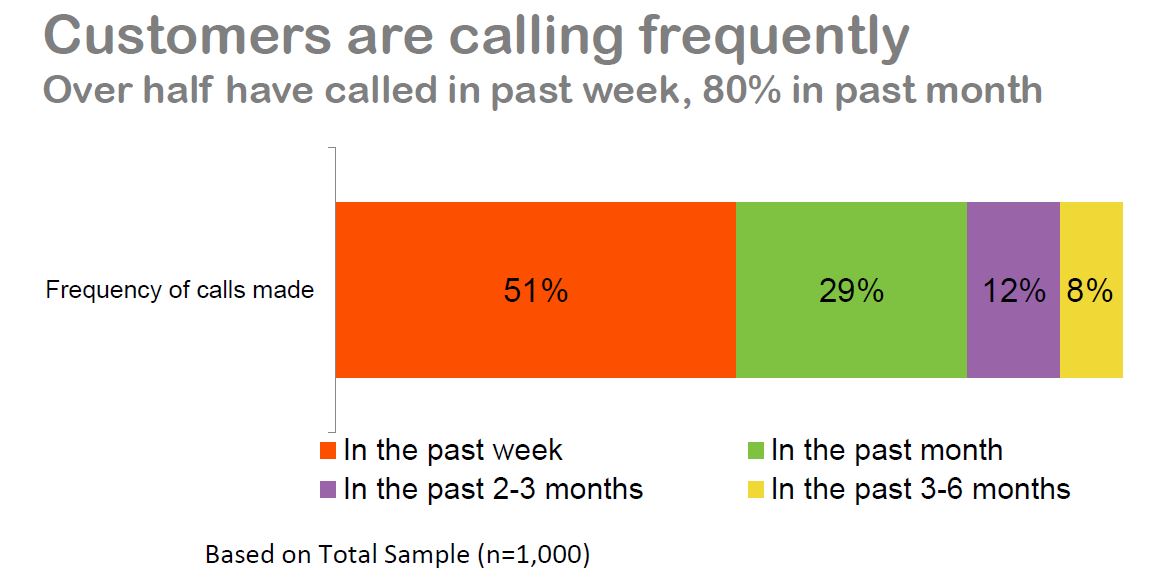
Unsurprisingly, the most frequently called sectors are daily service providers: media providers, utility suppliers, and financial organisations are among the top three.
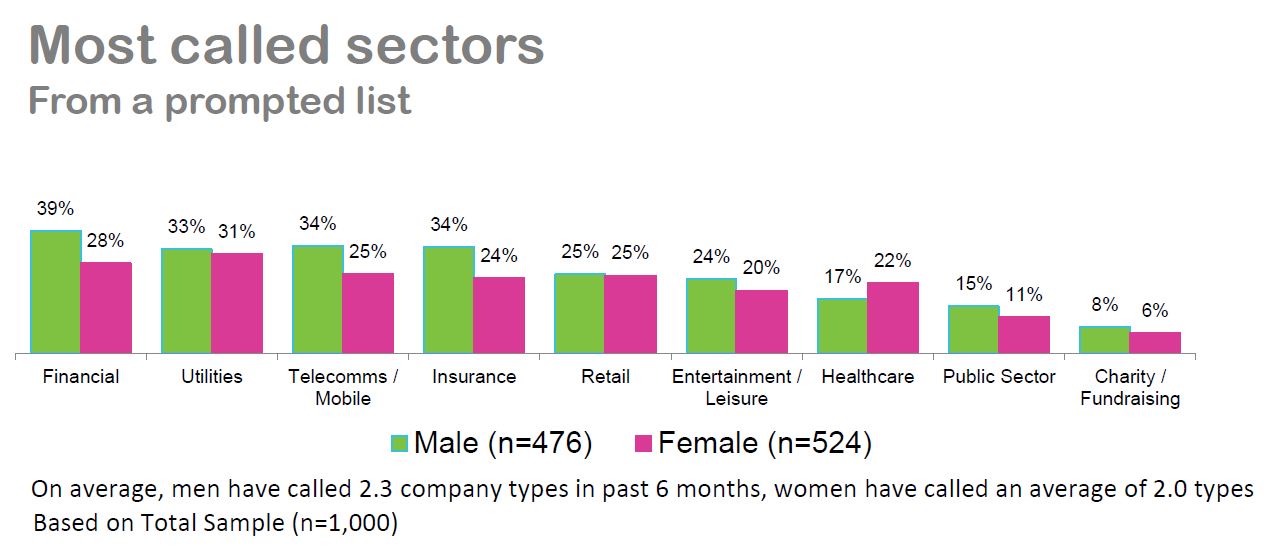
When it comes to understanding your customer base, the following gender and age insights can help your business manage calls received.
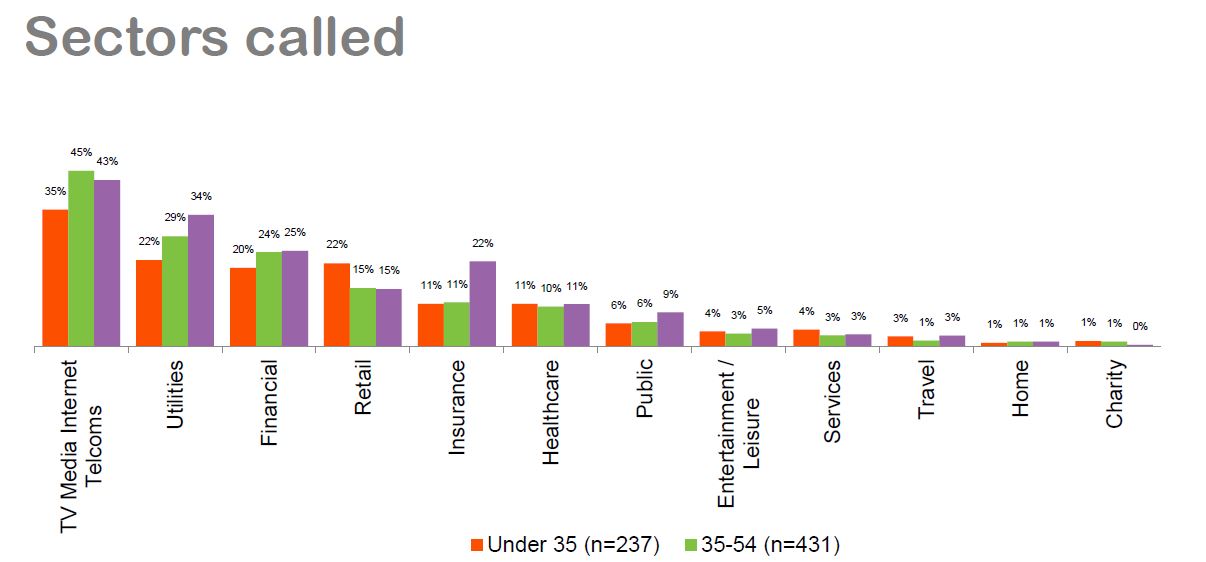
The frequency and volume of calls will vary depending on your business sector and other variables, such as the caller's age. Therefore, a clear understanding of your customer profile and any bias due to age could allow for a clearer indication of your business's likely call trends.
The likeliness of calls being made to utility companies was seen to increase with age. Calls to the retail sector were much higher among those aged under 35. The 55+ age group reported being more likely to contact Insurance companies compared to those in the 34-54 age group and the under 35’s.
When reviewing the fast-moving TV, Internet and Telecoms sector, those aged 35-54 made more calls to these organisations.
Contact centres deal with multiple customers daily. To ensure that calls and contacts are handled effectively, contact centres must create the right culture.
The culture of your business should be reflected within the contact points that your customers have with your company. Whether this is an internal receptionist or an outsourced contact centre team, the emphasis must be on 'doing the right thing' for the customer. This may mean taking a deeper look at the current external perception of the organisation, including how customers view your principles of trust and loyalty.
These areas create an emotional impact on your customers before they have even made contact with someone within your business. If the consumer’s perception of trust and loyalty is not reflective of where the business should be, then your contact centre team could be on the back foot when dealing with queries.
Best Contact Centres
Call agents who are patient and organised create the right balance of empathy and proactive support for a resolution. The most efficient agents develop creative problem-solving techniques to diffuse a challenging situation but remain determined to help their customers achieve their goals.
| Reason | Overall | Men | Women |
|---|---|---|---|
| A quick resolution | 38% | 42% | 35% |
| A positive attitude/willingness to help | 31% | 25% | 36% |
| Friendly and polite | 22% | 16% | 27% |
| Quick to answer | 20% | 22% | 19% |
| Listen / understand | 16% | 18% | 14% |
| UK contact centre / not foreign | 9% | 9% | 9% |
| Personal service | 9% | 5% | 11% |
They listen to my concerns or issue and treat me with respect…always very knowledgeable and offer good helpful solutions
Our research showed that men valued 'quick resolution', ‘quick to answer', and 'listening/understanding what I need' more than women. Women also favoured 'a positive attitude/willingness to help', ‘friendly and polite', and 'personal service' more than men.
Worst Contact Centres
Businesses must avoid keeping their customer on hold for too long by offering a smooth and easy process to gain access to a call agent. Once a customer reaches the agent they require a quick resolution from an agent who understands the business and the customers’ needs well. With a genuine desire to assist, the call agent must display empathy and have a good rapport with the customer.
Both men and women find unhelpful contact centres and those that keep them waiting in line the most annoying. For men, language issues are in 3rd place; for women, it's being sent around in circles without achieving anything. Women also found ‘Going round in circles’ and ‘rude/arrogant agents’ more disagreeable than men.
| Reason | Overall | Men | Women |
|---|---|---|---|
| Took too long to answer / on hold | 39% | 41% | 37% |
| Unhelpful / didn't resolve the issue | 34% | 32% | 37% |
| Difficult to understand / poor English | 18% | 21% | 16% |
| Going round in circles / transferred to different people | 17% | 10% | 25% |
| Rude / arrogant agents | 16% | 10% | 23% |
Takes too long to speak to a person if you even can.
Automated, pushbuttons, go round in circles, cut you off
Excellent service is built on experiences, emotions and ethics
|
The contact centre industry is susceptible to a high staff turnover so organisations need to work hard to retain its greatest asset: people.
These steps will help to acquire and retain a stable, knowledgeable and skilful team of contact centre agents.
Here at Whistl, we can provide tailored customer service solutions for your business needs. With an experienced team of call agents, we work as an extension of your team and business ethos. Our team answer your business calls with the right level of empathy and understanding to give each customer the time to resolve the challenge.

Contact Centre Solutions
Whistl works as an extension of your business; our agents handle all channels, so your customer experience is always exceptional.
Are You Making It Easy for Your Customers to Contact You?
If your customers need to contact you, are there peak call periods?
Understanding customer trends and associated behaviours could make your contact centre agents more effective when dealing with calls.
Evaluate the flow of your business and understand customer trends to manage the staffing level. In addition to the time of day, companies are affected by the day of the week or seasons, which affect the number and type of calls received. Think about the number of staff required, as well as the roles and experience necessary to handle the enquiries you are likely to receive.
Preferred time to call:
9 am until noon is the most preferred time to call
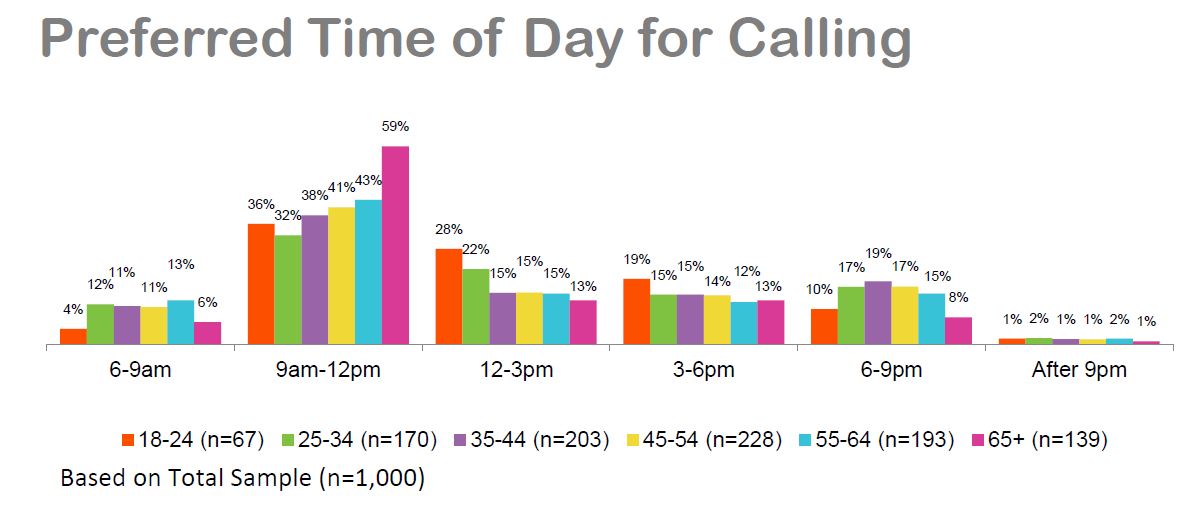
The 9 a.m. to 12 p.m. slot is preferred by people of all ages, but especially by the elderly, with 59% of those aged 65+ preferring to call at this time.
From 12 pm to 3 pm is the second most preferred time to call for those younger (18-34) and older (55+). However, for those aged between 35-54, 3 pm to 6 pm would be their second most preferred option.
Reasonable Time to Stay on Hold
Call volumes can vary based on the business sector, seasonality and other factors, which can all impact the length of time a customer stays on hold.
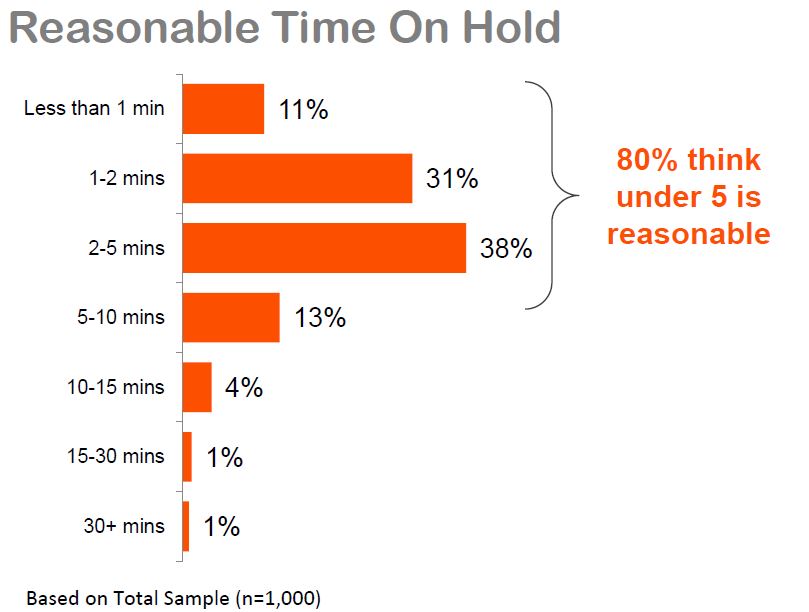
So how long is considered a reasonable period of time to stay on hold?
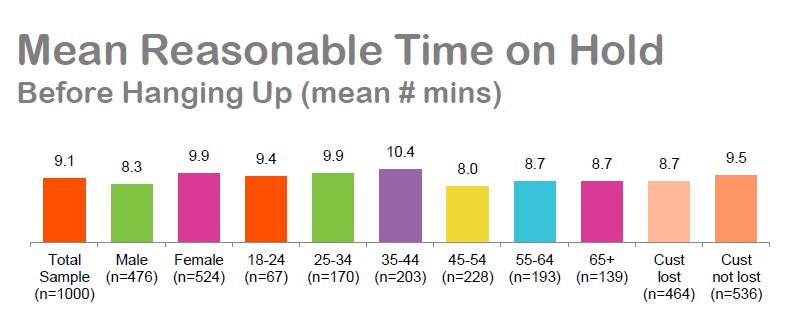
80% consider anything less than 5 minutes to be a reasonable time to be on hold.
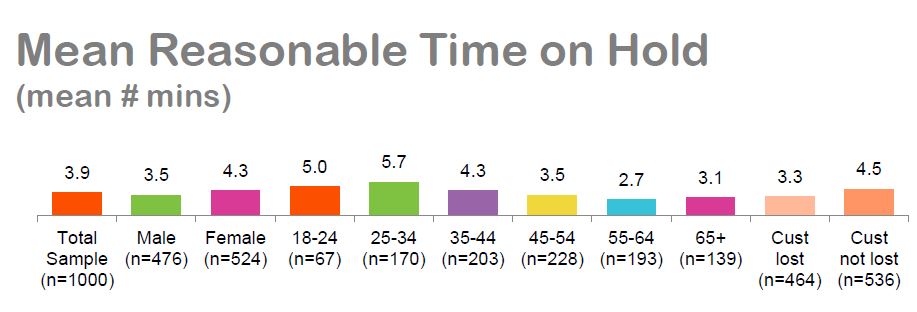
An acceptable time on hold is lower amongst men, with a mean average of 3.5 mins. For women the mean average was higher at 4.3 minutes.
Within the age group of 55-64-year-olds the mean average was the lowest when compared to all age groups, at 2.7 mins.
64% reported they would hang up after being on hold for 5 mins or more.
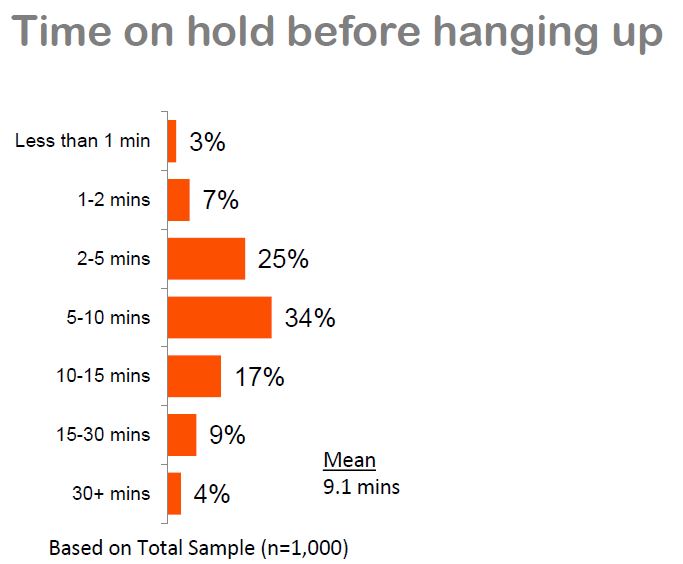
Men are more likely to hang up quicker than women, waiting only 8.3 minutes, with women waiting 9.9 minutes.

Do you callers find your technological support features helpful?
With technological advancements, contact centres have more options, such as guiding callers to the right department or managing call volumes with automated services. However, how many of these aspects do callers actually find helpful?
Assess the benefits each call centre integration offers your customer before installing a feature that frustrates rather than facilitates the customer journey.
Push-button Vs. Voice options
Voice recognition or voice response has significantly evolved over the years. It allows the customer to state the reason for their call, and the system comprehends the reaction.
However, our survey found that customers don't see this as a simple or easy function, with a staggering 86% of customers preferring push-button options to voice options. This more traditional option of keying in the number through the handset was the preferred method across all ages and gender.
The 'voice command' function is awful
I was constantly being put through to the wrong department due to the voice recognition inability to function properly
Voice response recognition is poor
My bank uses an AI machine that does not understand Irish accents so you spend 30 minutes on the phone with a robot that doesn’t understand you!!!!
Most Annoying Aspects of Contact Centres
When evaluating what your callers would find helpful when trying to contact your organisation, it is also good to understand what communication techniques are considered to be annoying or unhelpful.
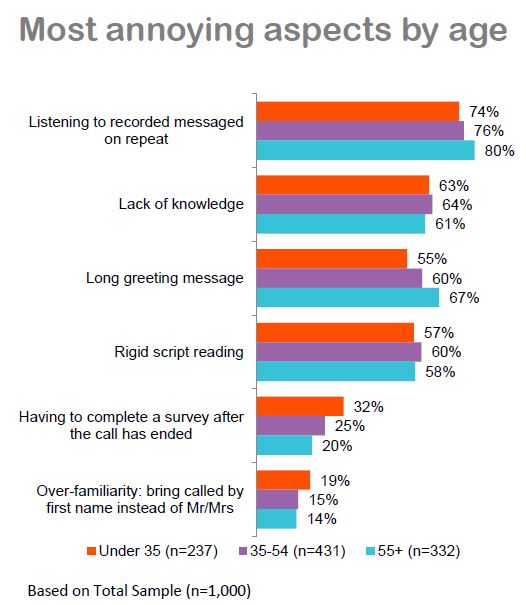
Our research has uncovered that there were four standout annoying aspects of contact centres.
Listening to repeated messages or long messages was more annoying for those over 55 years than those who were younger.
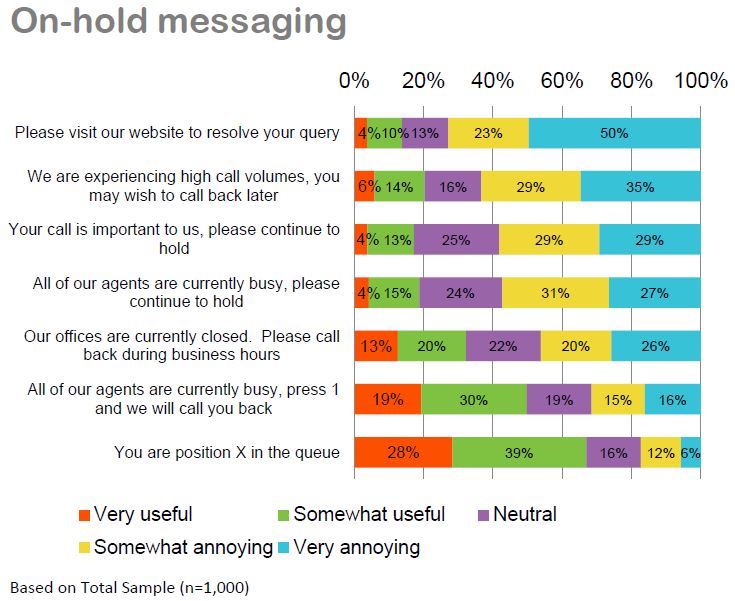
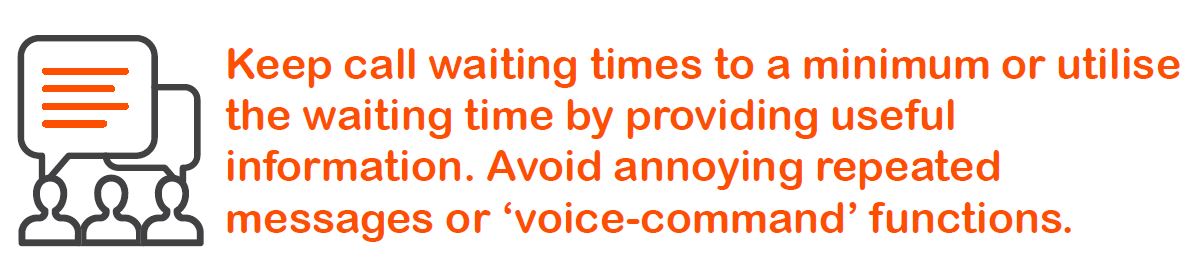
Although waiting time before a customer connects to an agent is usually unavoidable, it must be kept to a minimum. Try to use the waiting time by providing the customer with useful information.
Letting the customer know their position in the call queue and allowing them to select a callback are welcome features. However, messages directing customers to your website or asking customers to call back will leave them angry and irritated.
In a connected digital world, consumers want to contact organisations at different times of the day and through various channels.
How does your business market contact methods work, and are the options easy to find?
In a world of unlimited choice, do your customers have the flexibility to select the best method? When a selection of contact methods is offered, do those choices cater to your customer’s needs?
To improve communication, organisations should offer the range of channels necessary for their sector, considering their customers' preferences.
A wide range of communication channels are available in today's connected world. The UKCSI reported that customers who can use their preferred contact channel with an organisation are more satisfied with their overall customer experience than those who cannot.
| Channel Preference | % of Customers | Customer Satisfaction Index (out of 100) |
|---|---|---|
| Customers who used their preferred channel | 80% | 78.5 |
| Customers who did not use their preferred channel | 5.2% | 61.5 |
| Source: UK Customer Satisfaction Index (January 2020) |
Customers who wish to make a complaint or report a problem wish to do so by phone but less likely to opt for using social media, writing a letter, sending a text or using a mobile app.
| Channel used | % of Customers used for problems or complaints | % of these customers (not their preferred channel) |
|---|---|---|
| Phone | 360.5% | 15% |
| In Person | 25.7% | 6.9% |
| Website | 17.3% | 17.8% |
| 15% | 18.7% | |
| Webchat | 4% | 12.4% |
| App | 2.5% | 26.3% |
| Text | 2.1% | 45.8% |
| In writing (letter) | 1.6% | 31.4% |
| Social Media | 1.3% | 21.7% |
| Source: UK Customer Satisfaction Index (January 2020) |
When the UKCSI reviewed all channels used when reporting problems or complaints, they also found the highest majority used the phone with just over one-third of consumers using this channel, though 15% of these stated it was not their preferred channel choice.
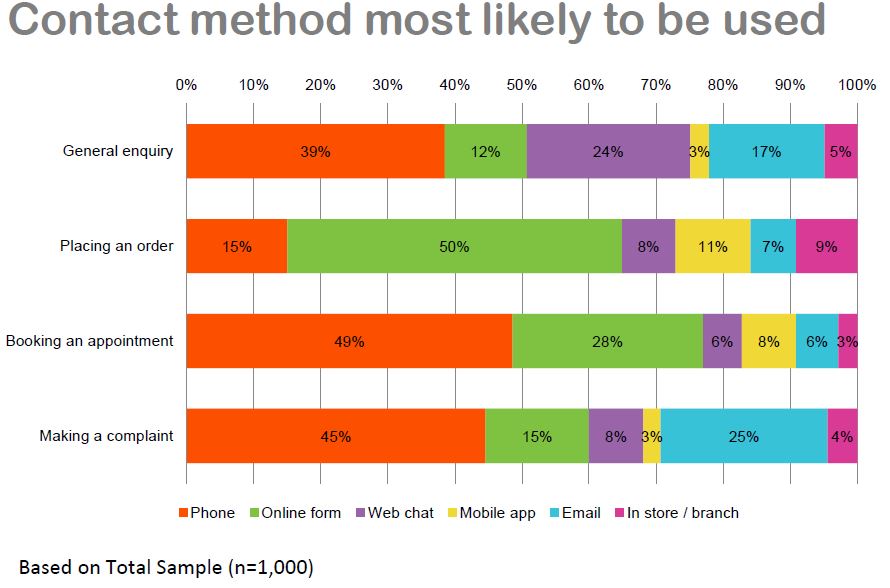
The findings from the UKCSI were supported by our findings with 45% of our respondents selecting the phone as their preferred choice of contact when making a complaint and 25% choosing to email.
When it comes to booking an appointment, 49% would call a contact centre with 28% going online. 39% of customers that had more general queries, said they'd pick up the phone, and 24% opted to talk through a webchat. To place an order, 50% opted to go online with only 15% wanting to place a call.
Within our research findings, we did see shifts in the preferences by age. With the more direct contact channels of phone calls and sending emails being more popular with the older age groups. Going on online, using a mobile app or webchat were more popular contact methods with those aged 18-34.
Contact Preference by Sector
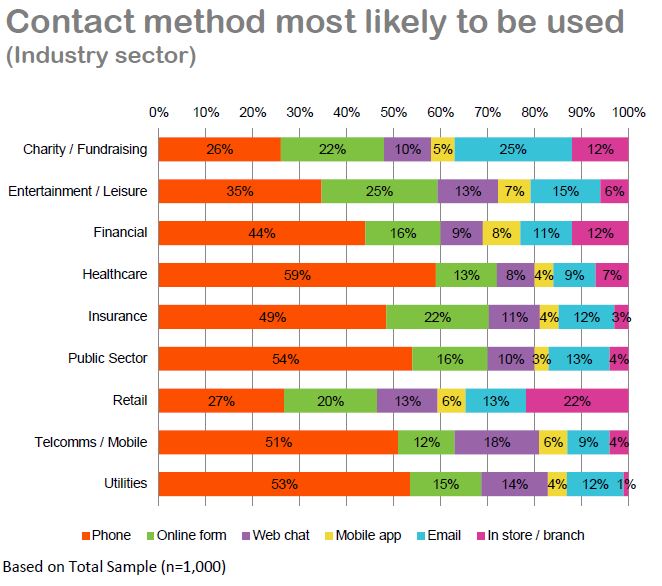
The sector being contacted also impacted how customers want to get in touch. More than 50% would prefer to pick up the phone to contact companies in the Healthcare; Public; Utilities; Telecom/Mobile sectors. Customers wanting to get in touch with the Charity or Retail sectors were more likely to use a diverse range of methods.

The effect of service on customer retention
Customer retention should remain a key performance indicator for any profitable organisation. Retaining your customer base and creating strong connections will ensure more trust and improved loyalty.
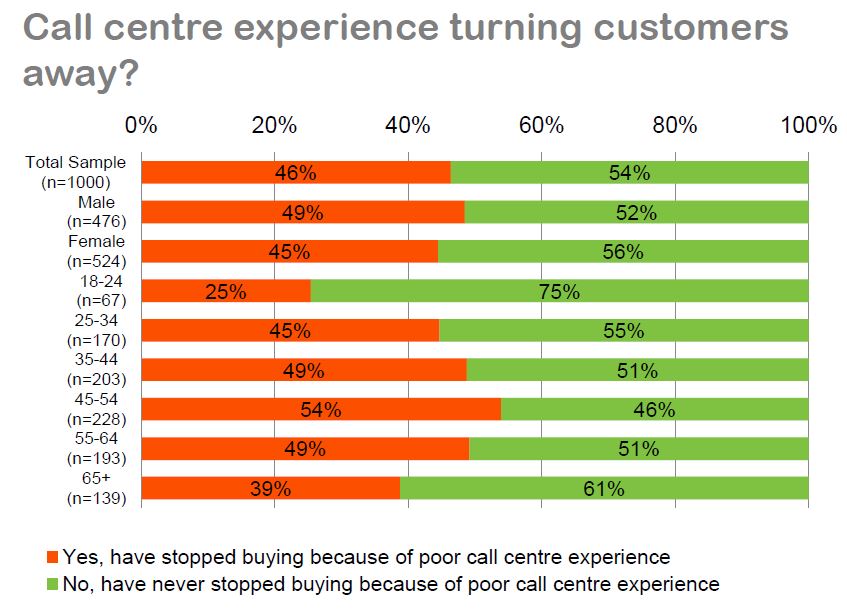
Almost half of the consumers claim to have stopped buying from companies due to a bad contact centre experience. Amongst the respondents, the older demographics are more likely to stop buying, with 54% of those aged between 45- 54 versus 25% aged 18-24.
|
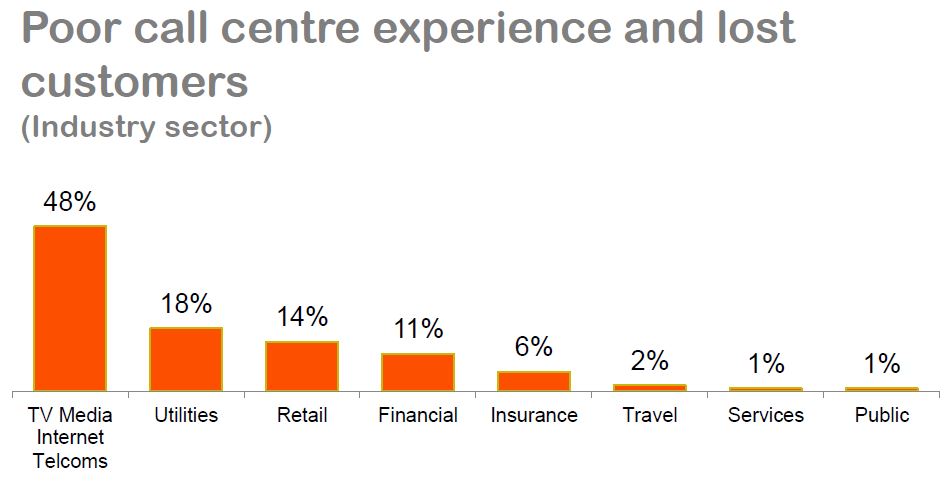
The daily service industries have the strongest correlation with vulnerability. Almost 50% of customers most likely to terminate relationships with companies offering TV, Internet and telecoms services if they have bad experiences.
46% (n=464) said they stopped using a company/organisation based on a poor call centre experience.
23% (n=229) mentioned the company/organisation/sector: %s below are based on these 229 respondents
I was transferred between various different agents and wasted over an hour trying to solve my problem only to then have one of the last agents hang up on me mid-conversation. I switched banks.

Our research-based guide has highlighted that across all ages, gender and industry sectors customers are still picking up the phone to connect to an agent in a contact centre. Managing customer calls promptly and effectively will help retain your customers and strengthen your relationship.
What customers want
Make the contact centre process easy and smooth, allowing the customer to speak to the right person with the correct answer. Have procedures in place that will enable a swift response and resolution. Customers want answers from agents who are willing to help. Avoid putting customers on hold for too long and bouncing them around different departments. Drop the repeated hold messages and rigid script reading in favour of helpful information.
Fully training call agents
Recruit, nurture, and maintain the right people. To do their best, they need to understand the customer as much as they need to understand your business. Ongoing training will equip your contact centre team with the information and skills they need to provide excellent service. They will also need to have the knowledge they need to be patient and help.
Sustained quality
Set KPIs and SLAs for your business and regularly monitor, report, and analyse results to achieve the best results. Aim to fully understand the results and your performance to continuously improve customer service. Stay up to date with communication trends to highlight areas for improvement. Be alert to changes in customer behaviours and requirements.
How Whistl Can Help Your Business
Here at Whistl, we can provide tailored customer service solutions for your business needs. Whether you require a dedicated team for all enquiries, your office has reached capacity, or you need help managing peak periods, our inbound customer service management could be the solution to all these challenges.
When outsourcing your contact centre services to Whistl, you receive the best support and customer service. We work to be an extension of your business, mirroring your brand guidelines and ethics to ensure that our connections with your customers align with the relationships you would look to create directly.
By outsourcing some or all of your contact centre solutions to Whistl, you gain access to a wealth of customer service experience and improved technologies. Whistl works across all business sectors and can manage all your customer interactions across relevant channels, providing your business with a seamless experience for every customer.
With tailored reporting, you can better understand your customers’ interactions with your business. Whether you need to understand more about contact patterns, the reasons for contacts, or how to improve trust or financial returns, Whistl can support your business with insight, guidance, and improvements to your customers' experience.
The Guide’s Research Methodology
The basis of this guide was developed using a research study of a representative sample of 1,000 UK adults, from a nationwide online panel. The respondents were screened on the frequency of an outgoing call made to companies or organisations.
Age ranges: The age range of those sampled is 18 to 65+. Generational differences were found within the survey with older age groups preferring to call rather than email, use web chat or mobile apps to contact organisations.
Gender: Gender differences were also found when looking at expectations. Men value a ‘quick resolution’ more than women. Women appreciated ‘a positive attitude’ more than men.
Sectors: The industry sectors focused on within our research were:
The support Micro Scooters get from Whistl is truly amazing. They completely share our ethos of putting our customers first. They’ve also helped us hugely understand our
J. Easter, Head of Customer Service, Micro Scooters
customers through advanced reporting and systems. They’re an invaluable part of our
team and most importantly, we know our customers are in good hands.
Whistl has been our trusted partner for over 14 years providing our online and retail business with the flexible, reliable support we need to allow us to concentrate on growing the business. We know our customers are safe in their hands!
Dick Jude, General Manager at The Noble Collection
We have been thrilled with the service that we have received over the past year. The team works as an extension of Elder employees by managing all inbound new-care enquiry calls, live-chat and also making outbound calls to people who have registered their interest online. Not only do they convert over 95% of calls to appointments with our sales team, but also provide fantastic customer service whilst doing so.
Mitchell Greenham, National Sales Manager, Elder