Whether you want to accelerate deliveries to your retail stores and customers, or need an efficient way to transport food, drinks, or pharmaceuticals without spoiling them, incorporating cross-docking into your supply chain will streamline your fulfilment process.
In addition to increasing the speed of your shipments, Whistl provides multiple types of cross-docking to maximise the size of your shipments while lowering your delivery costs.
This article explains the cross-docking process, the solutions Whistl can provide, and the benefits they offer to your fulfilment process.
What Is Cross-Docking?
Cross-docking is a supply chain management method that streamlines order fulfilment. Rather than temporarily storing goods before delivery to distribution centres, cross-docking involves processing inbound shipments in specially designed logistics facilities and immediately transferring the goods into outbound vehicles.
This allows large shipments to be organised into more manageable groups, while goods bound for specific locations can be consolidated into fewer vehicles. This expedites the delivery process while minimising the need for warehouse storage.
What Are The Different Types of Cross-Docking?
While there are multiple types of cross-docking, which we will cover in detail later in this section, the process can be separated into two distinct types:
-
Pre-distribution cross-docking
In this type of cross-docking, the customer and final destination for each product are determined before the product is shipped to the cross-docking distribution facility. This means that when the goods arrive at the facility, the handlers already have clear instructions for reorganising the products for the next step in their journey.
This method is typically used when manufacturers and retailers know how much inventory they need to meet customer and stockist demand. This type of cross-docking can eliminate the need for storage, as shipments can contain the exact amount of goods needed to fill available outgoing vehicles.
-
Post-distribution cross-docking
This type of cross-docking is essentially the inverse of the previous. Rather than having predetermined plans for how goods will be sorted and transferred to outgoing vehicles, the workers at the cross-docking facility will determine the products' final destinations upon arrival. As a result, goods are often temporarily stored at the facility until suppliers identify areas of high demand. At this point, products will be shipped accordingly.
While this system gives retailers more time to decide where to send their goods and avoid sending excess to secondary locations, cross-docking requires additional warehouse management to keep shipments easily accessible once the final destination is decided.
It is important to note that this system differs from the picking-and-packing approach to order fulfilment. Although both methods involve warehousing products for periods, goods are only picked and packed for dispatch after a customer has purchased them. In contrast, this type of cross-docking involves analysing purchasing habits to determine which locations will require stock of certain products.
These two approaches offer a broad view of cross-docking; however, three more types apply to one or both of these broader categorisations. These include:
-
Continuous cross-docking
As its name suggests, continuous cross-docking is an incredibly streamlined process that involves transferring products from inbound to outbound vehicles with minimal interruption. Rather than unloading and reorganising shipments, products are unloaded from inbound vehicles and immediately placed into outgoing trucks, ideally without any storage time.
This type of cross-docking falls under the pre-distribution approach and requires a high level of coordination between the manufacturers, suppliers, and the team operating the cross-dock facility. It is ordinarily used to ship large quantities of products in constant demand, such as food and perishables.
-
Consolidation cross-docking
While continuous cross-docking expedites the delivery process, consolidation cross-docking reduces shipping costs by consolidating products into a single larger outbound vehicle. This type of cross-docking involves storing multiple inbound shipments of the same products until there are enough to consolidate into one large outbound shipment.
This cross-docking method is favoured by less-than-truckload (LTL) carriers, which are logistics companies that specialise in delivering smaller loads for business-to-business (B2B) transactions. In international order fulfilment, businesses often use consolidation, which combines multiple loads into a single shipping container before transporting goods overseas.
As this post-distribution approach requires a cross-docking facility to store products for an extended period, companies should use an automated warehouse management system. This allows the facility to monitor their accumulated product, making it easier for manufacturers and retailers to coordinate.
-
Deconsolidation cross-docking
This type of cross-docking is effectively the opposite of consolidation. Instead of combining smaller loads into one larger shipment, larger incoming loads are divided into multiple smaller shipments for delivery to various locations nationwide.
This approach is common among parcel carriers, who often transport goods in larger loads when travelling between countries. They then split the shipments by region to deliver more effectively to customers. Retail shopping chains similarly use this method, as it allows them to transfer products from their distribution centres to their various branches around the country.
Which Businesses Benefit from Cross-Docking?
Due to the various types of cross-docking available, this supply chain management approach can benefit multiple businesses and industries. These include:
-
Food and drink companies
Agricultural produce and other perishables must be delivered within short timeframes to ensure retailers can supply their customers with fresh food and drink. Any delays in the supply chain will reduce the time products can sit on store shelves, decreasing retailer profits while increasing food wastage.
In addition to continuous cross-docking, which minimises the time food and drink spend in the supply chain, specially adapted temperature-controlled vehicles can preserve frozen and dairy products, reducing the risk of spoiling during transport.
For the retail sector to meet the demands of its consumer base, retail chains need to maintain a steady flow of products in their stores while managing their inventory to assess which products are the most popular. By leveraging the expertise of a cross-docking fulfilment centre, retailers can keep their stores well-stocked with staple products and develop insight into which products are being repeatedly replenished. Continuous cross-docking is similarly useful during seasonal shopping periods. Large quantities of seasonal goods can be delivered to multiple stores simultaneously, giving retailers the best chance to capitalise on these sales.
-
Automotive and chemical companies
Crucial parts and sensitive substances must be handled carefully and delivered promptly to satisfy the demands of the automotive and chemical industries. Cross-docking solutions support the transport of these goods under controlled conditions without repeated unloading, warehousing, and retrieval. This minimises the risk of damage to parts and materials during storage and streamlines the process, ensuring goods arrive precisely when needed.
-
Pharmaceuticals and time-sensitive products
Some medical products only maintain effectiveness at specific temperatures and when administered within certain timeframes. Cross-docking companies have access to temperature-controlled vehicles and can transfer pharmaceutical and other time-sensitive goods from one specialised truck to the next, eliminating the need for storage. This avoids the cost of environmentally controlled warehouses and reduces the risk of products being damaged or spoiled from repeated handling.
What Are the Benefits of Cross-Docking?
No matter your industry, there are numerous benefits to adopting cross-docking in your supply chain. These include:
-
Reduced shipping times
Depending on the type of cross-docking you choose, your goods will spend little to no time in warehouses. This streamlines the fulfilment process, so your business partners and customers can receive your products sooner. While offering faster shipping benefits to all businesses, this feature is especially valuable for retail and B2B suppliers, who can meet increasing consumer demand.
-
Reduced storage costs
Cross-docking can significantly lower your merchandise storage costs by minimising or eliminating the need to warehouse products during their journey from suppliers to customers. In addition to avoiding the expensive fees charged by environmentally controlled facilities, this system reduces other inventory management costs, such as tracking stock levels or shipment progress.
-
Reduced labour costs
The less time your goods spend handling along the supply chain, the less labour costs you can expect to pay. Cross-docking specialists primarily transfer inbound goods to outbound vehicles, significantly reducing the tracking and management required for each shipment. This is reflected in the amount they charge for their services.
-
Reduced shipping costs
- Whether your business is using consolidation or deconsolidation services, cross-docking allows you to minimise your shipping costs by consolidating multiple shipments into a single large shipment at a single stage in the process. By combining or dividing your shipments, you can carefully choose the size and quantity of vehicles you use to optimise your distribution.
-
Increased product handling efficiencies
By removing the need to unload your goods, place them in a warehouse, or retrieve and reload them into outbound vehicles, cross-docking achieves efficient handling by minimising the risk of your goods being damaged during transit.
What Are Whistl’s Cross-Docking Best Practices?
Whistl employs several best practices across our fulfilment and cross-docking facilities to provide our clients with an efficient order fulfilment process. From the layout of our facilities to how we handle your shipments, we have optimised every aspect of our cross-docking system to ensure your goods pass through our facilities without interruption or challenges. Our best practices include:
-
Facility and warehouse design
Our processing and warehouse facilities are strategically designed to minimise the distance inbound goods must travel before being loaded into their outbound vehicles. By utilising I-shaped buildings for continuous cross-docking and L-shaped facilities to accommodate consolidated goods, we have optimised our centres for cross-docking systems while reducing operational costs for our clients.
-
Dock door placement
By strategically spacing our dock doors, we have facilitated a consistent flow of goods between our inbound and outbound loading bays. This straightforward system has drastically reduced vehicle wait times at both ends of the supply chain while aiding the orderly flow of products through our facilities.
-
Advanced scheduling systems
Whistl coordinates its inbound and outbound vehicles through an advanced scheduling system to reduce wait times and ensure our facilities consistently operate at optimal capacity. This approach mitigates overcrowding and delays, and our scheduling system can be easily adapted to overcome unforeseen issues or increased demand during seasonal periods.
-
Real-time information systems
Collecting real-time data on the goods passing through our facilities allows us to provide our clients with accurate stock levels so that they can stay updated on their consolidated shipments. Once your goods are on the road, we continue to monitor their progress by sharing location information with our couriers.
-
Quality control measures
Our cross-docking fulfilment team reviews the integrity of your goods as they arrive and depart from our facility. They evaluate their condition in accordance with our rigorous quality control measures to prevent faulty or damaged products from reaching any further along your supply chain.
How Does Whistl Do Cross-Docking?
Where traditional cross-docking primarily handles stock that has already been sold to retailers or customers, Whistl can tailor its cross-docking services to its clients' needs. It can combine sold stock and inventory items in a single shipment. The diagram below illustrates how our cross-docking facilities can receive mixed shipments, transferring your sold stock onto outbound vehicles while redirecting your inventory to our fulfilment centres.
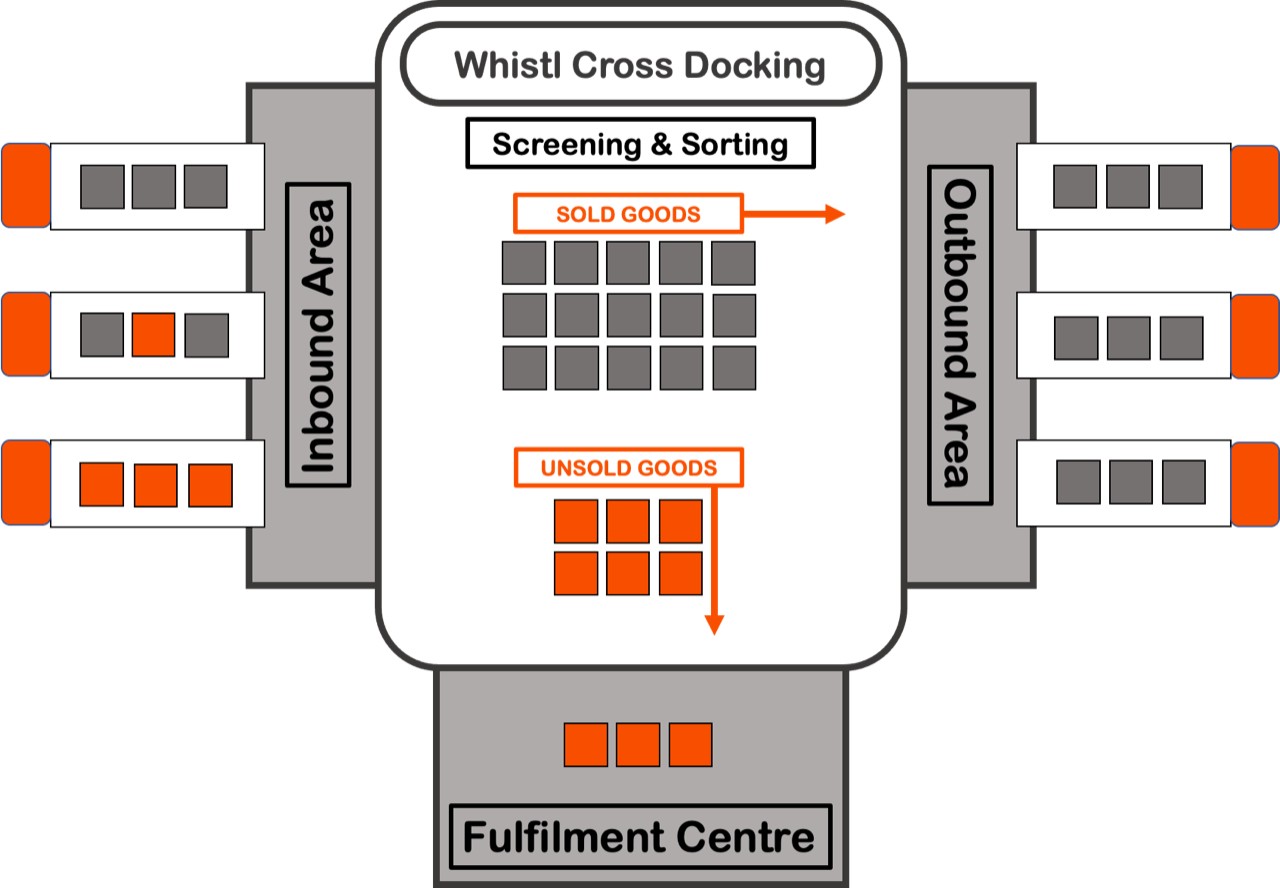
This option allows businesses to take advantage of larger consolidated shipments without needing the volume of orders ordinarily required to fill one of these vehicles. Our approach allows our clients to improve their cost efficiency and reduce the dispatch time for future orders by having surplus stock on hand.
If you are interested in what our cross-docking services can offer your business, contact our fulfilment team to discuss your business requirements.
Updated: March 2025
About Whistl Fulfilment
Whistl Fulfilment is one of the UK’s biggest and best providers of integrated multi-channel fulfilment and carrier management solutions. We work with over 50 brands, including Tesco F&F, SharkNinja and Microscooters.
Operating from six sites with over 1.5million square feet of multi-user warehouse space, we ship to customers in the UK and internationally at preferential parcel rates, leveraging our scale and proprietary Warehouse Management and Carrier Management platforms to deliver exceptional value

Scale with Confidence
Discover tailored fulfilment solutions that fit your business
Cross-Docking FAQs
What is a cross-dock warehouse?
Cross-dock warehouses are logistics facilities designed to streamline the transference of inbound shipments into outbound vehicles, reducing or eliminating the need for storage. When goods arrive at cross-dock warehouses, they are unloaded, processed, and reorganised into the appropriate outbound shipments. These are then promptly loaded onto outbound vehicles for delivery to stores and customers.
How is cross-docking different from warehousing?
While traditional warehousing involves unpacking and storing goods for extended periods before they are shipped to stores or customers, cross-docking minimises the time that goods need to be stored by sorting and transferring shipments onto outbound trucks as quickly as possible.
What is cross-docking in logistics management?
Cross-docking is a supply chain management method that accelerates order fulfilment by directly transferring goods from inbound to outbound vehicles. By limiting the time your goods spend in storage, cross-docking increases the speed at which goods are transferred through your supply chain while decreasing the amount you spend on inventory management.
Who uses cross-docking?
Cross-docking has been adopted by multiple industries that rely on the efficient and expedient delivery of goods from manufacturers to customers. While many supermarkets utilise cross-docking to provide fresh food and drinks to customers, different types of cross-docking can be incredibly beneficial for other industries, including retailers, automotive suppliers and pharmaceutical companies.
Can we arrange a visit to your warehouse to see the cross-dock layout?
Yes, site visits can be arranged directly with your account manager.
Join our mailing list
Sign up and receive all the latest industry news and insights directly to your inbox.
Research, Insights and Industry Guides
In depth insights and research studies to help you better understand customer perceptions & expectations.
Share this article
You may also like...