Written by
Leah Wolfenden
Head of Marketing
With thousands of UK retailers searching for 3PL-related queries each month, outsourcing third-party logistics is a popular strategic move. In this article, we cover the benefits and drawbacks of 3PL, examples of best practice and what’s involved, helping you determine whether outsourcing is the right solution for your business.
But first of all, what is a 3PL, and what does 3PL mean? 3PL stands for 'third-party logistics' and refers to the practice of entrusting a third-party provider (another business) to manage your logistics. If you're asking what 3PL is in logistics, or the meaning of 3PL in logistics, the meaning is straightforward: it means outsourcing key operations to a specialist. So, what are third-party logistics in practice? They cover the day-to-day activities that move orders from purchase to delivery. A 3PL is an external company that provides comprehensive 3PL services, including warehousing, order fulfilment, and shipping. These processes include importing goods, reworking, warehousing/storage, picking, packing and 3PL distribution. If you're searching for the meaning of 3PL logistics, it's simply the orchestration of these services by an external expert. An end-to-end provider such as Whistl will offer a wide range of services that can be added, including 3PL services like contact centre solutions, mail management, product sampling, print advertising services, and even cross-border import and export support. Service offerings can be tailored to the specific needs of UK eCommerce businesses, ensuring scalable and efficient logistics solutions.
Summary 3PL Guide:
This guide explains 3PL as outsourcing core logistics—warehousing, fulfilment, shipping, and related services—to specialist providers that move orders from purchase to delivery. It outlines how 3PL onboarding and WMS integration work, the main provider categories, recent innovations, and when to compare outsourcing with in-house operations. The article contrasts 3PL with 4PL and freight forwarding, noting benefits such as scalability, peak management, and sustainability, alongside trade-offs in control. It also highlights Whistl’s end-to-end, industry-focused UK eCommerce solutions and value-added services with multi-channel integrations to help brands scale.
How does third-party logistics work?
Entrusting another business to handle your end-to-end eCommerce logistics, including receiving, storage, picking, packing, distribution, returns, and customer service, is a highly involved process, this is how 3PL logistics typically works:
- Setting up with a third-party logistics provider: The first stage is for the retailer to meet with the logistics company so the 3PL can review the retailer’s technical infrastructure, product range, delivery requirements, and any other unmet needs. The third party will consider the client’s business objectives and how the 3PL can help the client meet its growth goals.
- Integrated third-party logistics - The second stage of how a 3PL works is the implementation process. This is when the logistics company’s IT team works with the retailer’s technical department to ensure the retailer's sales channels are integrated with the 3PL’s warehouse management system (WMS). This ensures both parties have transparency into stock levels, return rates, customer queries, and picking and packing speed and accuracy. Some providers go one step further and offer inventory management and reverse logistics to ensure the retailer avoids under- or over-stocking, thereby minimising waste and their carbon footprint. Fulfilment centres act as strategic facilities that enable efficient inventory storage, order processing, and distribution for eCommerce businesses.
- Once systems and processes are working in harmony, the retailer or the retailer’s supplier (second-party) will ship stock to the 3PL, at which point the logistics firm will begin determining the most appropriate storage locations and picking and packing methods. The benefit of utilising a WMS is that stock locations can be optimised based on which product types (SKUs) are most popular. Some 3PLs have their own warehouses, enabling them to customise and optimise fulfilment solutions to meet their clients' growth needs.
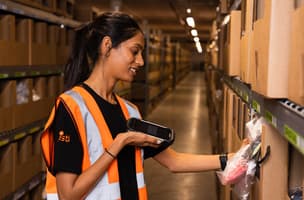
- When an order is placed, this generates a pick sheet or, if paperless, updates the warehouse team’s barcode scanners, allowing them to determine the product's pick location. The product is then taken to the packing area, where the shipping label is applied, and the parcel is ready for collection by the parcel carrier. This process includes the final-mile delivery, where 3PLs optimise the final stage to improve delivery times for customers.
Outsourcing delivery and supply chain logistics allows businesses to focus on their core competencies, rather than being bogged down by operational details.
Third-party logistics companies fall into four different key categories:
- Transportation-based 3PLs: With a core competency in transporting products, they can also offer a broader range of logistics services. They can either leverage the vehicles and sites of other firms or utilise their own. Transportation-based 3PLs often provide international shipping, supporting global reach for businesses expanding into new markets.
- Warehousing and distribution-based 3PLs: Specialising in all aspects of storage and distribution, many warehousing-optimised 3PLs also help retailers with the importing and exporting of goods.
- Freight forwarders: 3PLs who specialise in freight forwarding typically leverage third-party assets and act as intermediaries between the shipping location (third or first party) and the carrier hub.
- Managed transportation 3PLs: Specialising in end-to-end logistics services, managed transportation providers specialise in delivery management and often offer a wider range of fulfilment solutions.
What are the latest trends in the 3PL market?
In recent years, there has been rapid growth in demand for third-party warehousing, which has led the market to adapt with greater efficiency, including microwarehousing, splitting inventory across multiple warehouse locations, crowdsourced fulfilment, and automated storage and retrieval systems. Consumer demands for speed, accuracy, and sustainability have encouraged retailers and 3PLs to innovate in greener supply chains through reverse logistics and investments in robotics. 3PLs also help businesses manage peak seasons by scaling fulfilment capacity to handle increased order volumes without compromising service quality.
When is the right time to outsource with a 3PL provider?
While outsourcing with a third-party provider is a big commitment, it isn’t as capital-intensive as investing in a warehousing facility. As your online sales grow, you will naturally reach a point where handling your order processing in-house becomes overwhelming; your building and staff resources will be stretched.
The best way to determine the right time to outsource is to compare the cost of doing it yourself with outsourcing, and to consider the extra time you and your team will have to spend on other areas of running your business while a specialist handles picking and packing your orders.
What is 4PL, or fourth-party logistics?
While a 3PL focuses on logistics, a 4PL manages the entire supply chain. While an eCommerce department or the retailer’s founders would typically serve as the central point of contact for a 3PL, a 4PL would usually serve that role.
Knowing whether to work with a third or fourth party depends on the level of control you require and whether you need to develop certain elements of your logistics or your entire supply chain.
Is third-party logistics the same as eCommerce freight forwarding?
No, a freight forwarder typically focuses on moving goods from one location to another, whereas a 3PL handles storage, picking, packing, and distribution.
Some actionable tips to help you make that decision:
At Whistl, we provide outsourced third-party logistics solutions to mid-market retailers and brands across a range of industries. Before you decide whether to outsource key logistics processes, your entire supply chain, or retain these processes in-house, we recommend that you consider your long-term goals, your current digital maturity, and your seasonality of demand.
Take a close look at your customer feedback, and if there are any gaps in service quality that could be addressed by faster, more accurate order fulfilment, then outsourcing to a 3PL may be a viable option. Consider UK fulfilment and eCommerce logistics solutions designed specifically for UK retailers and brands to ensure seamless integration and growth.
Specialised 3PL Services for Different Industries
We understand that every industry has its own challenges when it comes to logistics and fulfilment. That's why we offer specialised services designed to address your unique needs, ensuring that you receive tailored solutions that support your growth and help you achieve your operational goals. We're not just another provider; Whistl partners with your business to provide logistics solutions that fit your business.
For ecommerce businesses, efficient online order fulfilment is essential to meet customers' expectations for fast, accurate deliveries. We offer multi-channel fulfilment that seamlessly integrates with your sales channels from web stores and marketplaces to social platforms like TikTok Shop. This ensures that your inventory, orders, and returns flow smoothly across all platforms, helping you deliver a consistent customer experience while maintaining complete control over your fulfilment operations. We provide tailored solutions, so you have a partner that makes 3PL simple.
Our logistics services go beyond basic warehousing and distribution. You benefit from value-added services such as custom packaging, labelling, kitting, and even promotional support, with the opportunity to reach new prospects with solutions like inserts. We have examined the entire supply chain to offer solutions designed to enhance your customer experience and support your brand differentiation. Our support helps you respond quickly to changing market demands and seasonal peaks while maintaining high standards of service that your customers expect.
Other industries, such as beauty, electronics, fashion and pet goods, also rely on our specialised expertise for fulfilment services that address strict regulatory requirements, handle sensitive products, and manage complex distribution networks.
When you work with Whistl, you are leveraging industry-specific knowledge and advanced technology to streamline your supply chain, reduce costs, and focus on your core business requirements.
Ultimately, our ability to provide flexible, industry-focused logistics services, combined with seamless integration across multiple sales channels, makes us a valuable partner for businesses looking to scale, enter new markets, and enhance customer satisfaction. We're here to help your business scale, not just handle your logistics.
Updated Feb 2026
Get in touch with our team today to learn more about Whistl’s third-party logistics solutions.
Who is Whistl Fulfilment?
Whistl Fulfilment is one of the UK’s biggest and best providers of integrated multi-channel fulfilment and carrier management solutions, working with over 50 brands, including Tesco F&F, SharkNinja and Microscooters.
Operating from six sites with over 1.5million square feet of multi-user warehouse space, we ship to customers in the UK and internationally at preferential parcel rates, leveraging our scale and proprietary Warehouse Management and Carrier Management platforms to deliver exceptional value.

Frequently Asked Questions: Third-Party Logistics
What does Whistl’s third-party logistics (3PL) fulfilment cover?
Whistl provides a full suite of fulfilment solutions, including secure warehousing and inventory management, pick-and-pack solutions, and last‑mile delivery management. In addition, we offer international shipping with compliance support, returns management, and custom packing and personalisation services. For businesses looking to improve customer experience, we also provide UK-based call and contact centre services to support your customers with enquiries, returns, and troubleshooting throughout every stage. Our services are tailored to your business. Complete the callback form to speak with a member of the team and find out more.
What are the main types of 3PL providers?
The four common categories are:
-
Transportation-based 3PLs, focused on moving goods and often enabling international delivery.
-
Warehousing and distribution-based 3PLs, specialising in storage, fulfilment, and import/export support.
-
Freight forwarders, acting as intermediaries to move freight using third-party assets.
-
Managed transportation 3PLs, offering end-to-end delivery management and broader fulfilment solutions.
What are the key benefits and trade-offs of outsourcing to a 3PL?
Benefits include scalability, the ability to handle seasonal peaks, faster, more accurate fulfilment, and sustainability gains through reverse logistics and modern, efficient operations (e.g., micro-warehousing, split inventory, automation). Outsourcing also frees your team to focus on the core business. The main trade-off is reduced direct control, though WMS integration helps maintain transparency over stock, returns, and performance.
When should a business consider moving to a 3PL?
Consider outsourcing when in-house processing strains your space and staff, when costs compare favourably with the in-house setup, and when customer feedback points to gaps in speed and accuracy. Whistl is on hand to help you review long-term goals, digital maturity, and seasonality. These questions will help you create a plan for when and how to decide if outsourced logistics is right for you. Speak to an expert today.
Join our mailing list
Sign up and receive all the latest industry news and insights directly to your inbox.
Research, Insights and Industry Guides
In depth insights and research studies to help you better understand customer perceptions & expectations.
Share this article
You may also like...