
Written by
William Geldart
Content Manager
From Valentine’s Day and an early Easter to a huge summer of sport and Black Friday, here are the key dates UK ecommerce brands need in their 2027 plans.
For eCommerce brands, a big date in the diary is rarely just a marketing opportunity.
A successful campaign will create demand for stock, put pressure on fulfilment and delivery, and invetiably lead to customer queries, exhanges and returns.
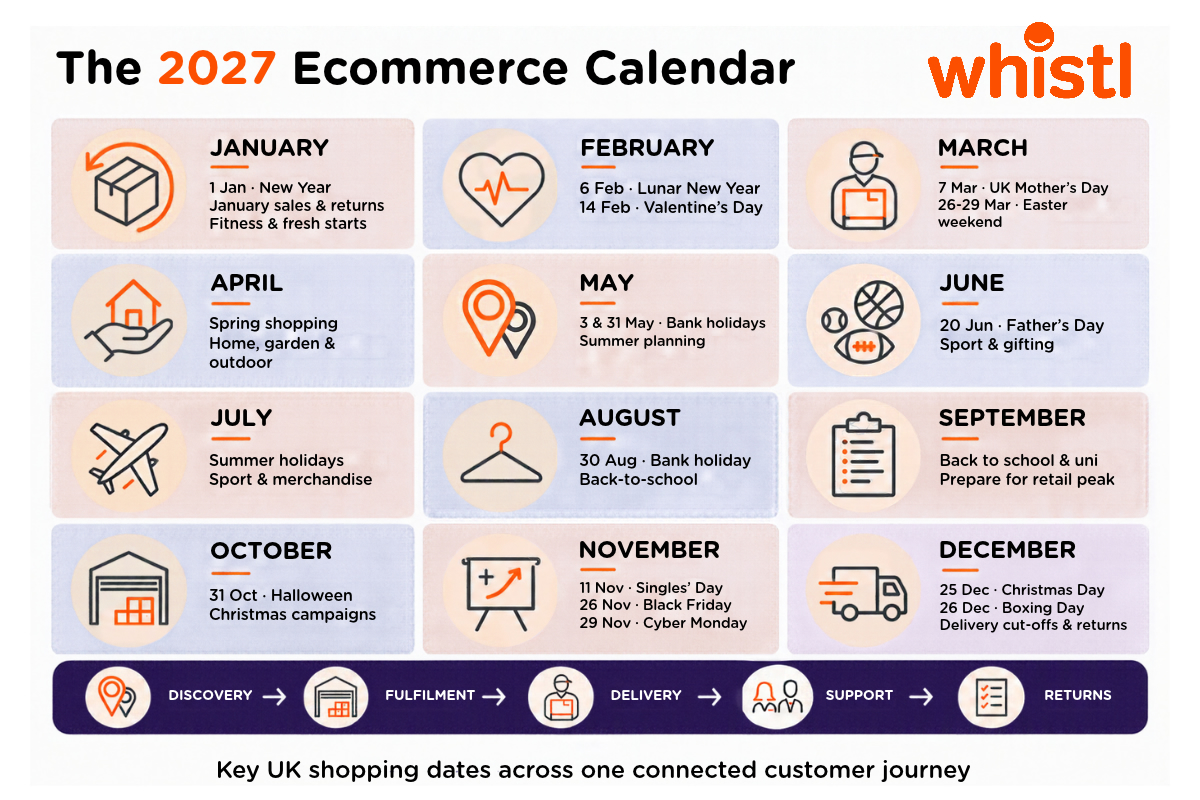
Our 2027 eCommerce calendar brings together the UK retail, seasonal and sporting moments worth planning for, alongside the customer journey considerations that can help turn them into successful peaks.
Key 2027 Ecommerce Dates: Quick Answers
When is Black Friday 2027?
Black Friday falls on Friday 26 November 2027, followed by Cyber Monday on Monday 29 November.
When is UK Mother's Day 2027?
Mothering Sunday is on Sunday 7 March 2027.
When is Easter 2027?
Easter Sunday is earlier than in recent years, on 28 March 2027, with Good Friday on 26 March and Easter Monday on 29 March.
When is Amazon Prime Day 2027?
The date has not yet been confirmed, so eCommerce brands should keep their mid-year promotional and fulfilment plans flexible. Some sources suggest it'll be another four-day event spanning Tuesday 29 June - Friday 2 July. Others suggest either 13 July or 15 July. So keep those eyes peeled!
What are the biggest UK ecommerce dates in 2027?
Alongside Black Friday and Christmas, key opportunities include Valentine's Day, Mother's Day, Easter, Father's Day, back to school and Halloween, plus major sporting events relevant to particular brands.
2027 Ecommerce Dates: At a Glance
| Date: | Event: | Ecommerce Opportunity: |
| 1 January | New Year / January sales | Sales, returns, health, fitness and wellbeing |
| January | Veganuary / Dry January | Food, drink, wellness and lifestyle |
| 6 February | Lunar New Year | International sourcing and inventory planning |
| 5 February–20 March | Six Nations | Merchandise, apparel, food, drink and hospitality |
| 14 February | Valentine’s Day | Major gifting occasion for loved ones |
| 7 March | Mother’s Day | Gifting, flowers, beauty, food and lifestyle |
| 26–29 March | Easter weekend | Food, gifting, family, home and spring retail |
| 10 April | Grand National | Fashion, food, drink and hospitality |
| 24–25 April | London Marathon weekend | Sport, fitness, charity and fundraising |
| 3 May | Early May Bank Holiday | Home, garden, leisure and travel |
| 6 May | UK local elections | Mail, door drop and public communications |
| 22 May | FA Cup Final | Merchandise, hospitality, food and drink |
| 31 May | Spring Bank Holiday | Summer retail and leisure |
| 5 June | Champions League Final | Football, merchandise and hospitality |
| 18 June–2 August | The Ashes | Major UK sporting opportunity |
| 20 June | Father’s Day | Gifting, grooming, tech and food |
| 24 June–25 July | FIFA Women’s World Cup | Merchandise and sports-led campaigns |
| 28 June–11 July | Wimbledon | Sport, fashion, food and drink |
| 2–25 July | Tour de France | Sport, cycling and lifestyle |
| 4 July | British Grand Prix | Motorsport, merchandise and experiential |
| July, TBC | Amazon Prime Day | Ecommerce promotional peak |
| July–September | Back to school | Clothing, footwear, tech and stationery |
| 30 August | Summer Bank Holiday | Late summer retail |
| 17–19 September | Ryder Cup | Sport, fashion, hospitality and travel |
| 1 October–13 November | Men's Rugby World Cup | Sports-led retail and merchandise |
| 4 October–21 November | Men's ICC Cricket World Cup | Sport, food, drink and merchandise |
| October, TBC | Prime Big Deal Days | Early Q4 promotional peak |
| 31 October | Halloween | Food, costume, beauty, home and entertainment |
| 11 November | Singles’ Day | International and cross-border ecommerce |
| 26 November | Black Friday | Major eCommerce peak |
| 29 November | Cyber Monday | Major online promotional peak |
| 4 December | Small Business Saturday UK | Independent and DTC brands |
| December | Christmas delivery deadlines | Delivery, tracking and customer communications |
| 25 December | Christmas | Peak gifting, some online sales begin |
| 26 December | Boxing Day | Sales and returns |
January 2027: Sales, Returns and Resolutions
The year starts with demand moving in both directions.
January sales sit alongside growing interest in health, fitness, organisation and wellbeing. Meanwhile, unwanted Christmas purchases are making their way back.
For retailers, that puts returns management firmly in the spotlight. Products that can be inspected, processed and returned to sellable stock quickly have a much better chance of generating revenue again.
Veganuary and Dry January can also provide useful hooks for food, drink, wellness and lifestyle brands, where there is a genuine connection to the product.
February 2027: Sourcing and Selling
Lunar New Year – 6 February
Not every important ecommerce date is a sales event.
Lunar New Year begins on 6 February 2027, making advance inventory management particularly important for brands sourcing products or components from Asia.
Six Nations – 5 February to 20 March
The Six Nations provides several weeks of opportunities around sportswear, merchandise, food, drink, hospitality and home viewing.
Valentine’s Day – 14 February
Valentine’s Day falls on a Sunday, putting extra emphasis on the delivery promise for flowers, jewellery, beauty, confectionery, fashion and personalised gifts.
For hard-date gifting occasions, getting the parcel there at the right time is part of the product.
March 2027: Mother’s Day and an Early Easter
Spring arrives early in the retail calendar.
Mother’s Day – 7 March
UK Mothering Sunday falls early, on 7 March 2027. Beauty, flowers, jewellery, food, gifting, homeware and lifestyle brands should therefore have campaigns and stock plans ready earlier than usual.
There's an offline opportunity too. Direct mail and catalogues can put gifting inspiration into people's hands before they start actively searching online.
Easter – 26 to 29 March
Good Friday is 26 March, Easter Sunday 28 March and Easter Monday 29 March.
That gives brands just six weeks between Valentine’s Day and Easter, with Mother’s Day in between. For businesses serving all three, spring could feel like a mini peak.
April 2027: The Start of an Epic Sporting Year
April brings a run of UK sporting moments:
- 10 April: Grand National
- 17 April–3 May: World Snooker Championship
- 24–25 April: London Marathon weekend
For relevant sports, fashion, fitness, food and drink brands, opportunities can extend beyond digital campaigns into merchandise, fulfilment, physical media, customer engagement and local activation.
However, relevance beats opportunism. Not every brand needs to attach itself to every big event. Although there's quite a few for sports fans...more coming up later.
May 2027: Local Reach and Long Weekends
The Early May Bank Holiday falls on 3 May, followed by the Spring Bank Holiday on 31 May, creating natural opportunities around home, garden, leisure, travel and summer shopping.
UK local elections – 6 May
The UK local elections aren't a retail event, but they matter for organisations handling large-scale public communications.
For political organisations, councils and public bodies, planning can encompass targeted mail, door drop distribution, accessible communications and contact handling.
FA Cup Final – 22 May
A major moment for football merchandise, hospitality and relevant food and drink brands.
June and July 2027: Stacked Summer
This is where the calendar gets busy.
The Ashes takes place from 18 June to 2 August, the FIFA Women’s World Cup from 24 June to 25 July, and Wimbledon from 28 June to 11 July. July also brings the Tour de France, British Grand Prix and The Open.
There’s Father’s Day on 20 June too.
That creates opportunities across apparel, merchandise, sporting goods, food and drink, electronics, beauty, grooming and hospitality.
But successful moments like these need connected planning.
A campaign might create demand for merchandise. That stock needs storing and fulfilling. Parcel capacity needs to absorb the spike. And when a customer needs an exchange before the next match, customer service becomes part of the same experience.
What about Amazon Prime Day 2027?
Keep it in the plan, but keep the date flexible.
The event moved significantly in 2026 and Amazon had not confirmed its 2027 dates at the time of writing. Other eCommerce calendars therefore either list it as TBC or describe a July date as a forecast.
August and September 2027: Summer Holidays and Back to School
Back-to-school demand runs across clothing, footwear, stationery, books, technology and sports equipment.
The Summer Bank Holiday falls on 30 August, while September brings the Ryder Cup from 17–19 September.
And there's plenty of other jobs to be done.
It's time to stress-test:
- Inventory forecasts
- Fulfilment capacity
- Carrier arrangements
- Packaging
- Returns
- Customer-service forecasts
- Peak contingency plans
October 2027: Peak Gets Going
Amazon's Prime Big Deal Days are expected in October, although dates remain to be confirmed.
Sport remains busy too. The Men's Rugby World Cup runs from 1 October to 13 November, while the ICC Men's Cricket World Cup takes place between 4 October and 21 November.
Then Halloween lands on 31 October.
For eCommerce operations, October is the point when campaign calendars, stock, fulfilment, delivery and customer-support plans all need to be working together.
November 2027: Ecommerce in Full Swing
Singles’ Day – 11 November
Particularly relevant to brands selling internationally or exploring cross-border eCommerce.
Black Friday – 26 November
Black Friday falls on Friday 26 November 2027. But Black Friday is no longer confined to one day. For many brands, it's a promotional period lasting much of November.
Cyber Monday – 29 November
Cyber Monday follows on Monday 29 November.
December 2027: Deliver the Promise
Small Business Saturday UK – 4 December
Unlike its U.S equivalent, Small Business Saturday UK falls on 4 December 2027, making it particularly relevant for independents, DTC businesses and local brands.
Christmas – 25 December
Christmas Day falls on a Saturday in 2027.
Final carrier cut-offs will vary, but the principle for retailers doesn't:
Make the delivery promise clear. Then make sure your operation can keep it.
That means realistic cut-offs, appropriate delivery choices, proactive tracking communications and enough customer-service capacity to handle inevitable last-minute questions.
Then Boxing Day arrives, sales restart and returns begin flowing back.
Ready to go again?
Plan for the Customer Journey
The real lesson from the 2027 eCommerce calendar is that every successful campaign creates an operational consequence.
- A catalogue can create a website visit.
- A sporting event can trigger a rush for merchandise.
- A Black Friday offer can create a spike in orders.
- A delivery problem can become a customer-service conversation.
- A Christmas gift can become a January return.
Customers don't see separate marketing, fulfilment, delivery and customer-service functions. They see one brand, and the delivery experience is part of the product.
So when you're planning 2027, think beyond the campaign headlines and ask the following questions:
- What demand could this create?
- Have we got the stock?
- Can we fulfil the volume?
- What's our delivery promise?
- Can customers reach us when they need help?
- What happens when products come back?
That's how dates in a calendar become better customer experiences.
Ready for your 2027 Peaks?
Whether you need to reach new customers, manage stock and fulfilment, deliver orders or handle the conversations that follow, planning ahead makes peak easier to manage.
Share this article
You may also like...